
Editorial note: This article is for general skincare education only. It does not diagnose, treat, or replace advice from a dermatologist, OB-GYN, or other licensed clinician. If you are pregnant, breastfeeding, using prescription medications, or dealing with persistent or severe symptoms, confirm product and ingredient choices with your healthcare provider.
Somewhere in your early-to-mid 40s, you start hearing about retinol from everyone. Your dermatologist mentions it at your annual visit. Your friends are using it. The internet insists you should be on it. And yet most of the women who try it for the first time at 45 quit within a month, convinced their skin “can’t handle it.”
It can. The issue is almost always how it was started, not whether your skin tolerates the ingredient. This guide gets the introduction right.
What retinol actually is
Retinol is a form of vitamin A that you apply to your skin. It belongs to a broader family of compounds called retinoids — all of which are converted by your skin into the active form, retinoic acid.
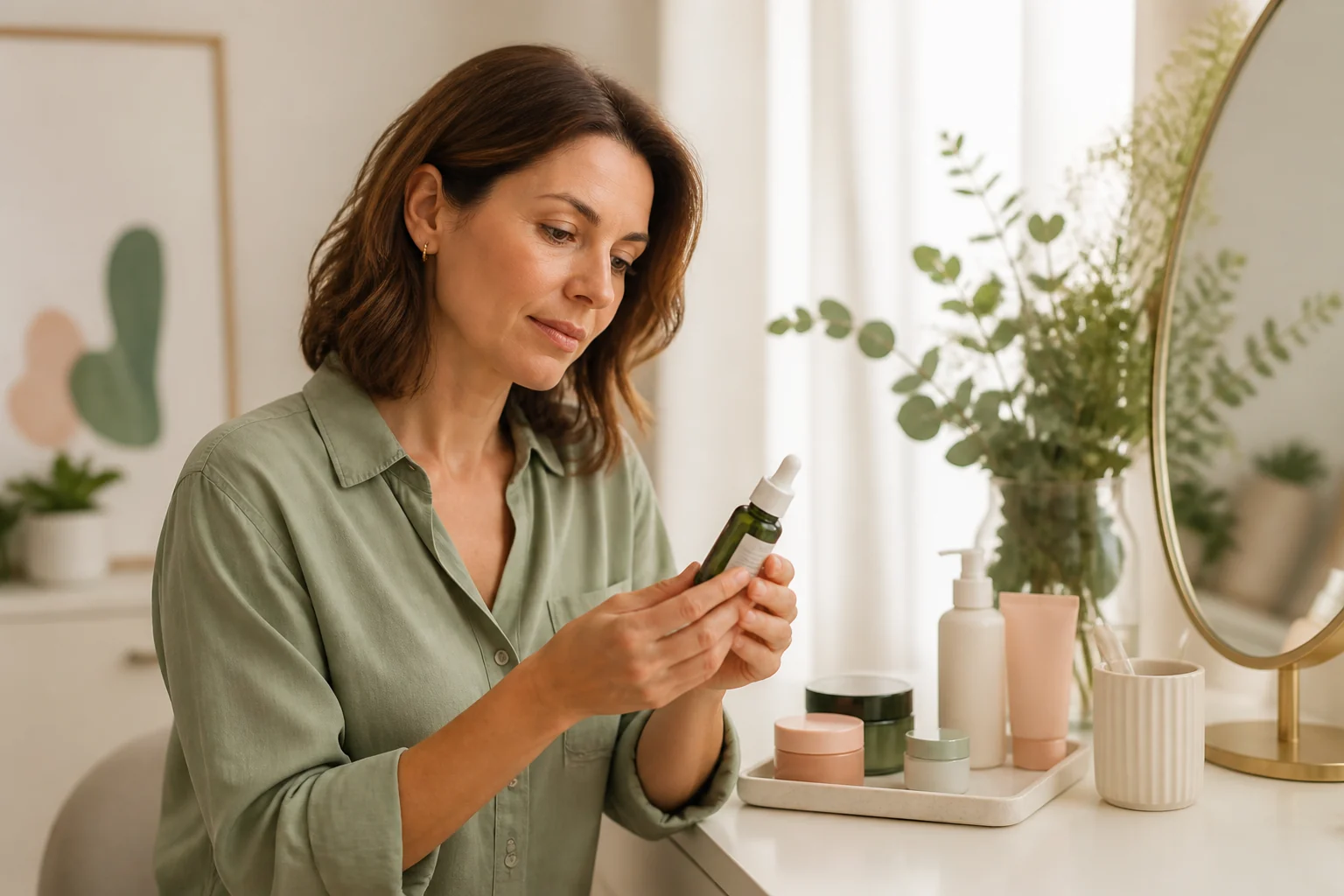
The retinoid family includes (from gentlest to strongest):
- Retinyl esters (retinyl palmitate, retinyl acetate) — weakest, requires several conversions to become active
- Retinol — the most common over-the-counter form. Requires one conversion step inside the skin.
- Retinaldehyde (retinal) — one step closer to active. More potent than retinol at the same percentage.
- Adapalene — a third-generation synthetic retinoid, available over the counter as Differin 0.1%. Highly stable, effective, well-tolerated.
- Tretinoin (Retin-A) — the active form itself. Prescription only. The most-studied retinoid.
- Tazarotene — prescription, stronger than tretinoin, less commonly used cosmetically.
For practical purposes, when we say “retinol” we usually mean over-the-counter retinol products. When we say “retinoid” we mean the whole family, including prescription tretinoin.
What retinol does in your skin
Retinol signals your skin to do several things that decline with age:
Increases collagen production. Collagen — the structural protein that keeps skin firm — drops about 1% per year starting in your 20s. The decline accelerates after menopause. Retinol tells fibroblasts (the skin cells that make collagen) to ramp up production. Studies consistently show measurable collagen increase after 6+ months of use.
Speeds cell turnover. Skin cells naturally cycle from base layer to surface to shedding in about 28-40 days in younger skin, slowing to 60+ days by middle age. Slow turnover causes the dullness, rough texture, and stubborn dark spots characteristic of mature skin. Retinol accelerates this cycle.
Fades hyperpigmentation gradually. The faster cell turnover combined with retinol’s effect on melanin distribution helps fade sun spots, melasma, and post-inflammatory hyperpigmentation over 4-6 months.
Reduces fine lines and improves skin texture. The combination of collagen stimulation and improved turnover creates visible change in skin smoothness and fine line depth. Deep wrinkles improve less dramatically; fine lines respond best.
Improves overall radiance. Aged skin develops irregular cell stacking that reflects light poorly. Retinol restores more organized cell architecture, which reflects light more uniformly — what we perceive as “glow.”
What retinol won’t do
Setting expectations honestly:
- Won’t erase deep wrinkles. Etched lines around the eyes, deep nasolabial folds, and significant volume loss are addressed by injectables or surgery, not topicals.
- Won’t lift sagging skin. Loss of facial structure due to bone resorption, fat redistribution, and significant collagen loss requires energy-based treatments (Ultherapy, RF microneedling) or surgical intervention.
- Won’t work overnight. Real visible change begins around week 8-12 of consistent use. Substantial changes happen at 6 months. The most noticeable improvement is at 12-18 months.
- Won’t replace sunscreen. Without daily SPF, retinol-treated skin actually accumulates UV damage faster because the surface layer is thinner.
Why most women over 40 quit retinol too early
The common pattern: woman buys a 1% retinol product, applies it every night, gets red and peeling within a week, decides her skin can’t tolerate retinol, never tries again.
What actually happened: she skipped the slow introduction (called retinization) that her skin needed. Retinol restructures skin function — that’s why it works — and that restructuring causes temporary side effects.
The right approach makes retinol tolerable for the vast majority of women, even those with sensitive skin.
How to actually start retinol in your 40s
Step 1: Choose the right strength
Start lower than you think you need. Recommended starting concentrations:
- Very sensitive or first-time users: 0.1-0.25% retinol
- Normal skin, never used retinoids: 0.25-0.5% retinol
- Skin that’s used to gentle actives: 0.5-1% retinol
- Adapalene (Differin): 0.1% is the standard OTC strength and works well as a first retinoid
Higher percentages (1.5%+) are not categorically more effective. They produce more irritation without dramatically better results for most users. Skip the marketing emphasis on percentage.
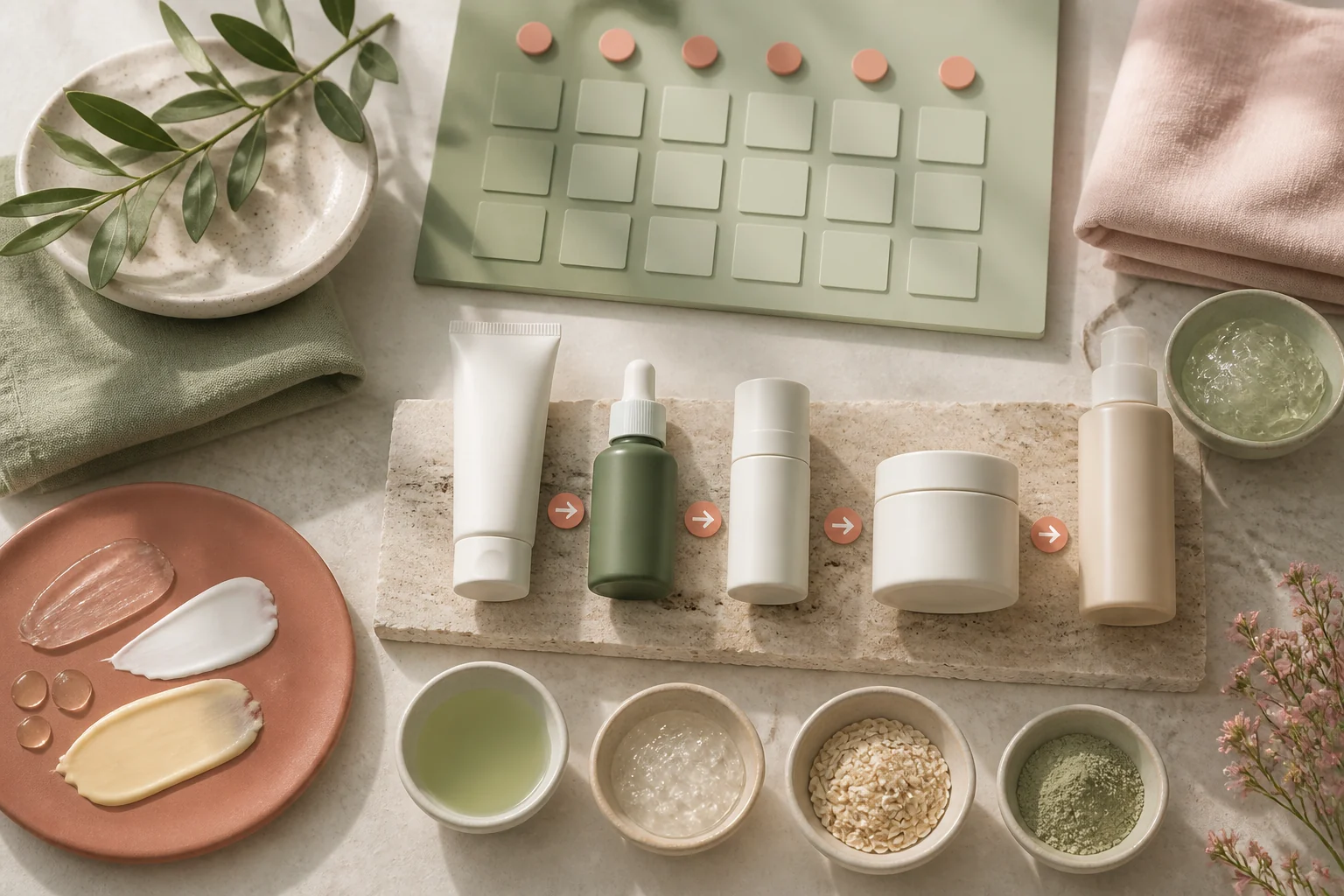
Step 2: Build up gradually over 3 months
The slow start is the difference between success and quitting:
- Weeks 1-2: Apply once per week. Pea-sized amount to entire face (avoid eyelids and corners of mouth). Apply at night, to dry skin, followed by moisturizer.
- Weeks 3-4: Twice per week, non-consecutive nights.
- Weeks 5-6: Three times per week.
- Weeks 7-8: Every other night.
- Weeks 9-12: Nightly, if your skin is tolerating well. Some women never need nightly use — every other night is fine maintenance.
If you hit irritation (sustained redness, persistent peeling, burning sensation), drop back to the previous frequency for another 2 weeks before progressing.
Step 3: Apply correctly
- Always at night. Retinoids are degraded by UV and increase photosensitivity.
- To dry skin only. Damp skin absorbs retinol more aggressively and intensifies irritation. Wait 15-20 minutes after washing.
- Pea-sized amount for the entire face. More is not better — more is just more irritation.
- Avoid the eye area, corners of the mouth, and the crease around the nose. Thin skin in these areas reacts more strongly.
- Moisturize afterward. Generous application of a barrier-repair moisturizer (ceramides, hyaluronic acid) reduces irritation significantly.
Step 4: Buffer if needed
For very sensitive skin, the “sandwich method” helps tolerance:
- Apply moisturizer to clean dry skin
- Wait 5 minutes
- Apply retinol
- Apply another layer of moisturizer over the top
This reduces the concentration that actually reaches your skin and dramatically reduces irritation. As your skin adjusts, you can drop the first moisturizer layer.
Step 5: Manage the unavoidable side effects
Even with a slow start, expect some adjustment effects in the first 2-8 weeks:
- Mild flaking or peeling — normal, indicates the cell turnover is happening
- Slight pink tinge after application — normal if it resolves within an hour
- Some dryness — manageable with moisturizer
- Brief stinging on application — typically resolves within 1-2 minutes
Not normal, and reason to pause:
- Sustained redness lasting hours after application
- Burning that doesn’t subside
- Open or weeping areas
- Pustules or new breakouts that persist beyond 4-6 weeks
- Significant swelling
Best retinol products for women over 40 — by category
Entry-level retinols (gentle, easy to tolerate)
- The Inkey List Retinol Visible-Aging Serum ($10) — 1% encapsulated retinol with squalane. Surprisingly well-tolerated for the strength. The squalane buffers irritation.
- Olay Regenerist Retinol 24 ($30) — moisturizer with retinol and niacinamide. Easy entry point because the moisturizing base reduces irritation. Concentration is modest (good for starters).
- RoC Retinol Correxion Deep Wrinkle Night Cream ($25) — drugstore stalwart, 0.5% retinol equivalent. Decades of formulation refinement.
- Cerave Resurfacing Retinol Serum ($18) — encapsulated retinol with ceramides and licorice extract for redness control. Excellent first retinol.
Mid-strength options ($25-60)
- Naturium Multi-Retinol Treatment ($30) — combines retinol, retinyl palmitate, and bakuchiol. Multi-pronged approach.
- Paula’s Choice 1% Retinol Treatment ($60) — well-formulated, stable, no fragrance.
- The Ordinary Retinal 0.2% Emulsion ($20) — retinaldehyde is more potent than retinol at the same percentage, with similar tolerance.
- Skinceuticals Retinol 0.3 ($88) — premium option with excellent stability and uniform release. Worth it if you want predictable results.
Adapalene (often the best first retinoid)
- Differin Gel (adapalene 0.1%) ($15) — available over the counter at any drugstore. Prescription strength in a gel base. Excellent tolerance, well-studied for both visible-aging and acne. This may be the single best retinoid choice for most women over 40 who haven’t used a retinoid before.
Prescription tretinoin (when over-the-counter isn’t enough)
If you’ve worked your way up to nightly OTC retinol and want stronger results, prescription tretinoin is the next step. Available at 0.025%, 0.05%, and 0.1% strengths. More aggressive than equivalent OTC retinol — start at 0.025% and progress slowly.
Telehealth services (Curology, Hers, Apostrophe, Dear Brightly) make prescription tretinoin accessible without an in-person dermatology visit. Many provide custom formulations combining tretinoin with niacinamide or azelaic acid.
What to pair (and not pair) with retinol
Pair well
- Ceramide moisturizers — support barrier recovery, reduce irritation
- Hyaluronic acid serums — applied first, add hydration to retinol-treated skin
- Niacinamide — reduces inflammation, supports barrier, fades hyperpigmentation alongside the retinol
- Peptides — different mechanism, complementary effects
- Sunscreen (always) — especially important when using retinoids
Use cautiously or separate by time
- Vitamin C — generally fine, but some sensitive users find the combination too aggressive. Use vitamin C in the morning, retinol at night.
- Other exfoliants (AHAs, BHAs) — possible but increases irritation risk. Most dermatologists recommend using these on the off-nights from retinol, not the same evening.
- Benzoyl peroxide — can degrade retinol when applied at the same time. Separate by 12 hours (one in morning, one at night).
Avoid
- Stripping cleansers, harsh exfoliating scrubs — your skin doesn’t need more aggression while it’s adjusting
- Other retinoids in your routine — pick one and stick with it
- Waxing or threading on retinol-treated skin — pause retinol for 5-7 days before any hair removal procedures
What to expect at each milestone
Month 1: Mostly adjustment. Some dryness or flaking. No visible change yet.
Month 2-3: Skin starts looking smoother. Slight brightening. Old breakouts may have surfaced and resolved.
Month 4-6: Visible improvement in fine lines, especially around the eyes. Texture is noticeably smoother. Sun spots are fading.
Month 6-12: Substantial improvement. Friends comment on your skin. Foundation looks different (sits better).
Year 1+: The compounding effect. Year 2 of retinol use produces additional improvement on top of year 1. By year 3, most users have meaningfully different skin than they had pre-retinol.
Special situations
Rosacea or extreme sensitivity
If you have rosacea or you’ve reacted badly to gentle actives in the past, traditional retinol may be too aggressive. Better alternatives:
- Bakuchiol — plant-derived retinol alternative without the irritation profile. Slower results, much better tolerance.
- Retinaldehyde (retinal) in low concentrations — sometimes better tolerated than retinol despite higher potency.
- Prescription topical tretinoin under dermatologist supervision — counterintuitively, prescription tretinoin in tiny amounts is sometimes better tolerated than OTC retinol because the formulation excludes irritating co-ingredients.
Perimenopause and menopause
Hormonal changes during perimenopause and menopause make skin more reactive and drier. You may need to:
- Drop back from nightly use to 2-3 times per week
- Use the sandwich method (moisturizer-retinol-moisturizer) regularly
- Switch to a lower concentration if you were on a higher one
- Pair more aggressively with barrier-repair products
The retinol still works during menopause — your skin just needs more support around it.
Pregnancy and breastfeeding
Do not use retinol, retinoid, or any vitamin A derivative during pregnancy or breastfeeding. Bakuchiol is the pregnancy-conscious alternative to discuss with your clinician.
When to see a dermatologist
- Persistent irritation that doesn’t resolve with the sandwich method or reduced frequency
- Interest in prescription-level options
- Concerns about specific skin conditions (rosacea, melasma, eczema) that may complicate retinol use
- If you’d like a more aggressive visible-aging protocol — combining retinoids with in-office treatments produces faster results than topicals alone
Frequently asked questions
I’m 50 and have never used retinol. Is it too late?
No. Skin remains responsive to retinoids throughout life. The improvement may be more gradual than it would have been at 35, but it’s real. Many women see the most striking visual improvements when they start retinoids in their 50s and 60s simply because the contrast is more visible.
Can I use retinol around my eyes?
Carefully, yes. Avoid the eyelid itself (skin too thin), but the orbital bone area and outer corners benefit from retinol. Many dedicated eye creams now include retinol in modest concentrations specifically formulated for the delicate eye area.
What’s the difference between “retinol” and “retinoid”?
Retinoid is the family name; retinol is one specific type. Prescription tretinoin and over-the-counter adapalene are also retinoids but not retinol specifically.
Does retinol thin the skin?
Counterintuitively, no — it does the opposite. Retinol thickens the deeper layers of skin by stimulating collagen and supporting skin structure. The very thin outer dead-skin layer (stratum corneum) is temporarily reduced, which is what creates the brief sensitivity to sun and irritants during retinization. The functional, structural skin underneath becomes thicker and more resilient.
Can I use retinol every night, forever?
Yes. Long-term studies (20+ years) show no harm from prolonged retinoid use, and the benefits continue to compound. Many women in their 70s and 80s have been on prescription tretinoin since their 40s without issues.
Will I look bad while my skin adjusts?
Honestly, sometimes yes. The first 2-8 weeks can involve visible peeling, slight redness, and breakouts as the skin restructures. This is why dermatologists recommend starting in winter (less sun, easier to hide indoors) or before a stretch when you don’t have major events.
The bottom line
Retinol is the most-studied, most-effective topical for visible skin aging — and it works as well in your 50s and 60s as in your 30s if you use it correctly. The critical move is starting slowly: low concentration, low frequency, gradual build over 12 weeks, generous moisturizer, daily sunscreen.
For most women over 40, the best first retinoid is either Differin Gel (adapalene 0.1%, $15) for those who can tolerate moderate strength, or CeraVe Resurfacing Retinol Serum ($18) for those wanting an entry-level retinol with built-in barrier support. Both are accessible, well-studied, and effective.
Stick with it for at least three months before judging results. By month 6, you’ll see the difference. By year 1, so will everyone else.