
Editorial note: This article is for general skincare education only. It does not diagnose, treat, or replace advice from a dermatologist, OB-GYN, or other licensed clinician. If you are pregnant, breastfeeding, using prescription medications, or dealing with persistent or severe symptoms, confirm product and ingredient choices with your healthcare provider.
If you’ve encountered “cica” creams, “tiger grass” ampoules, or “Madagascar centella” essences in the past few years, you’ve encountered centella asiatica — one of the most-marketed and, refreshingly, one of the better-evidenced botanical ingredients in modern skincare.
Centella isn’t a miracle ingredient. But unlike many botanical actives, the research behind it is real, and the use cases are well-defined. Here’s what it is commonly used for, who benefits, and how to use it well.
What centella asiatica is
Centella asiatica is a small, low-growing herbaceous plant native to wetlands across Asia. It’s been used in traditional Ayurvedic, Chinese, and Indonesian medicine for centuries — primarily for wound healing, inflammation, and skin conditions. The plant goes by many names: gotu kola, Indian pennywort, tiger grass (referring to the folk story that tigers rolled in it to heal wounds), brahmi (an Ayurvedic name).
In modern skincare, “centella asiatica extract” can refer to several things:
- Whole-plant extracts containing the full spectrum of compounds
- Standardized extracts called “TECA” or “TTFCA” containing specific concentrations of the active components
- Isolated individual compounds: madecassoside, asiaticoside, madecassic acid, asiatic acid
The four pentacyclic triterpenes (madecassoside, asiaticoside, madecassic acid, asiatic acid) are the most-studied actives. Madecassoside, in particular, is often the headline ingredient in higher-end “cica” products because it has the strongest research backing for anti-inflammatory and wound-healing effects.
What the research actually shows
Centella has more clinical evidence behind it than most botanical actives. The most relevant findings:

Anti-inflammatory effects
Multiple studies have shown topical centella reduces visible redness, skin reactivity, and inflammatory markers. This is the primary use case in modern skincare and the area where the evidence is strongest. A 2008 study in the journal Clinics in Dermatology reviewed the available research and concluded that centella’s anti-inflammatory effects are well-documented.
Wound healing
Centella has been used clinically for accelerating wound healing for decades. The asiaticoside component appears to stimulate collagen production and accelerate the closure of wounds. Studies have shown improved healing of surgical wounds, burns, and chronic skin lesions.
Improved barrier function
A 2016 study published in the Journal of Cosmetic Dermatology showed centella extract improved skin barrier function in subjects with sensitive skin over 8 weeks. Transepidermal water loss decreased, and reactivity to standard test irritants decreased.
Mild visible-aging effects
Centella’s collagen-stimulating effects translate to some visible-aging benefit. A 2013 study of 0.1% madecassoside cream over 6 months showed improvement in elasticity and fine wrinkles. The effect is modest compared to retinoids, but it’s real and the ingredient is far gentler.
Helpful for stretch marks (risk reduction)
Centella has shown modest benefit in reducing stretch mark severity in some pregnancy studies. Topical centella creams used during pregnancy have shown reduced striae development compared to placebo in several small trials. The effect is modest, but the ingredient is commonly discussed as lower-risk during pregnancy, but confirm with your clinician and well-tolerated.
Helpful for rosacea-related redness
While not specifically FDA-approved for rosacea, several studies have shown centella reduces visible redness in rosacea-prone skin. Korean dermatology research, where centella products are deeply integrated into clinical practice, has been particularly supportive.
Who benefits most from centella
Centella is most useful for:
- Sensitive, reactive skin that flushes easily or struggles to tolerate stronger actives
- Rosacea — both as supportive care and to reduce visible redness
- Recovering, compromised skin after over-exfoliation, retinoid introduction, or post-procedure (laser, microneedling)
- Pregnancy and postpartum skin — gentle, well-tolerated, broadly often considered lower-risk
- Mature skin with thinning, fragile barriers — mature skin tends to have lower ceramide production and weaker barrier function; centella helps support this
- Skin healing from breakouts or post-inflammatory hyperpigmentation
- Anyone tolerating actives poorly who wants to support skin recovery while taking a break from harsher products
Centella is less useful (though not harmful) for:
- Treating active acne — it’s anti-inflammatory but not effective against acne specifically
- Significant hyperpigmentation — vitamin C, niacinamide, azelaic acid, or retinoids do more
- Deep wrinkles or significant photoaging — too gentle to drive meaningful change
How to read a centella product label
The market is flooded with “centella” products of varying quality. Some have meaningful concentrations; many are using centella as a marketing buzzword with token amounts. What to look for:
Specific compound names
Better products list specific actives: “madecassoside 0.1%,” “asiaticoside 0.5%,” or “TECA complex.” These tell you what’s actually in the product.
Position in the ingredient list
“Centella asiatica extract” listed in the first half of the ingredient deck (especially the first 10 ingredients) means there’s a meaningful amount. Listed near the end? Probably trace amounts.
The K-beauty influence
Many of the best centella products come from Korean brands, where cica has been a clinical mainstay for years. K-beauty centella ampoules tend to have higher concentrations and well-formulated bases. Dr. Jart+, Skin1004, Purito, and Cosrx are reliable brands.
Avoid “centella + everything else” products
Some products combine centella with retinoids, strong acids, or fragrance — defeating the purpose. If the product is supposed to be calming, look at the rest of the ingredient list.
Specific product recommendations
Best entry-level (under $20)
- Skin1004 Madagascar Centella Ampoule — pure centella ampoule, 100% centella asiatica leaf water as the first ingredient. Cult favorite for good reason.
- Cosrx Centella Blemish Cream — centella for inflammatory acne
- Purito Centella Green Level Buffet Serum — combines centella with peptides and niacinamide
- The Ordinary Soothing & Barrier Support Serum — contains beta-glucan, centella, and other calming actives
Mid-tier ($20–$40)
- Purito Centella Unscented Sunscreen SPF 50+ — mineral sunscreen with centella, gentle
- Dr. Jart+ Cicapair Tiger Grass Cream — combines centella with niacinamide and color-correcting tint (green tint that neutralizes redness)
- Dr. Jart+ Cicapair Tiger Grass Serum — higher-concentration centella, anti-redness focus
- Some By Mi Snail Truecica Miracle Repair Cream — combines centella with snail mucin (controversial but tolerated by most)
Premium ($40+)
- La Roche-Posay Cicaplast Baume B5 — French pharmacy classic with madecassoside and panthenol. Multipurpose: post-procedure, dry patches, lips, hands. A staple of European dermatology practices.
- SkinCeuticals Phyto Corrective Gel — combines centella with thyme and cucumber. Anti-redness focus.
- Sunday Riley Pink Drink Firming Resurfacing Essence — centella plus pomegranate enzymes
- Dr. Barbara Sturm Calming Serum — luxury option with centella and other anti-inflammatory actives
How to incorporate centella into a routine
Centella is one of the easier actives to use because it’s so well-tolerated. The standard approach:
Starting protocol
- Patch test inside the forearm for 3 days
- Apply to face 3 evenings per week for the first 2 weeks (after cleansing, before moisturizer)
- Increase to nightly if well-tolerated
- Optional: add a morning application after 4 weeks
Where to place it in your routine
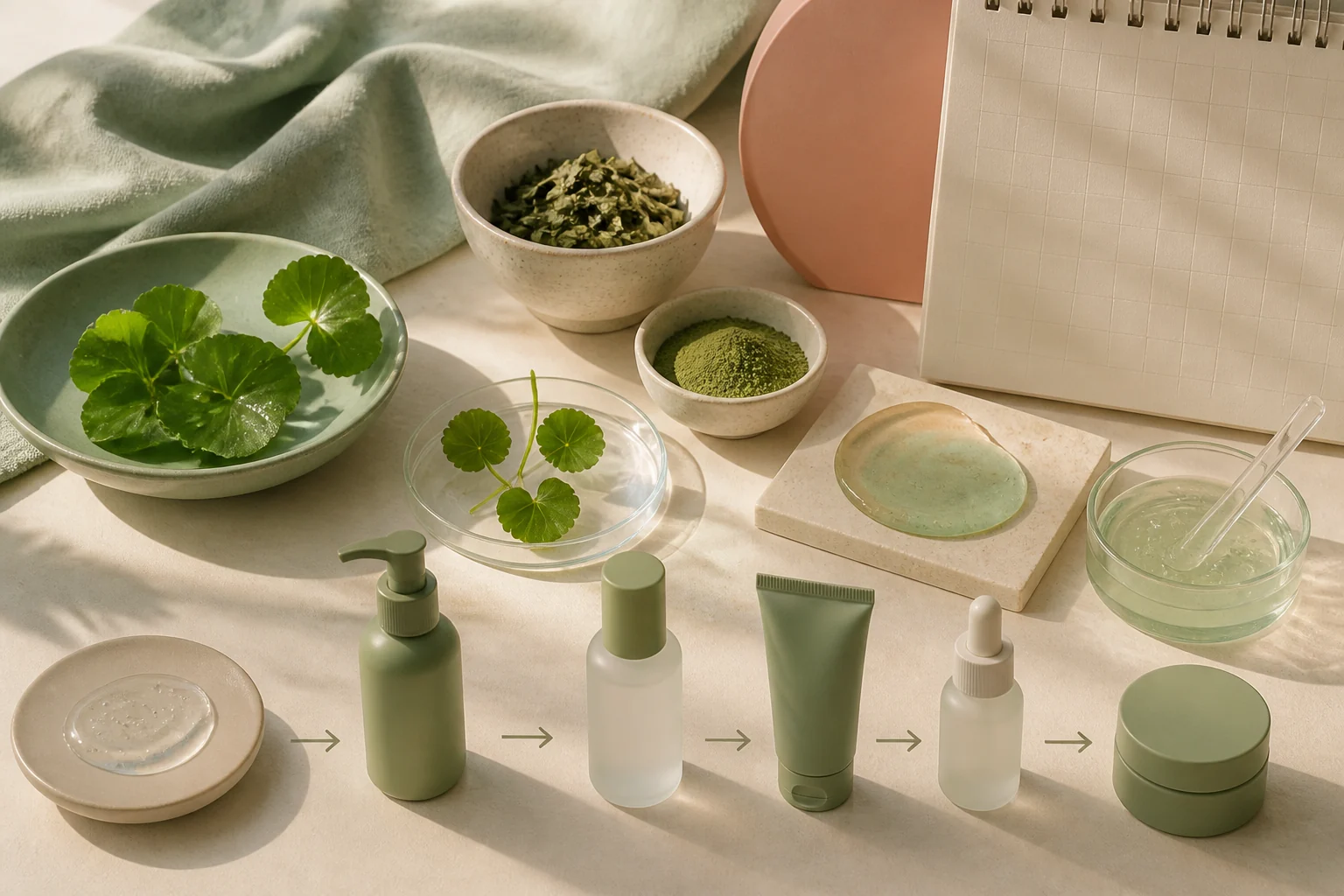
After cleansing, before moisturizer. If using multiple serums:
- Water-based actives (vitamin C, niacinamide) first
- Centella ampoule/serum second
- Moisturizer last
Centella plays well with virtually everything — niacinamide, hyaluronic acid, peptides, vitamin C (gentle derivatives), gentle exfoliants. It can also be used on its own as a recovery treatment when you’re taking a break from harsher actives.
Pairing with stronger actives
One of centella’s most useful roles is as a barrier-supporting partner to harsher actives:
- With retinoids: apply centella under or after the retinoid to soften irritation. Some routines alternate — retinoid one night, centella the next.
- With acids: centella the night after exfoliating helps the skin recover
- With benzoyl peroxide or other drying acne treatments: centella ampoule before moisturizer reduces post-treatment irritation
What centella won’t do
To set expectations honestly:
- It won’t transform skin texture dramatically. The improvements are subtle and accumulate over weeks to months.
- It won’t replace retinol for visible-aging effects. The collagen stimulation is modest compared to true retinoids.
- It won’t fade established hyperpigmentation. It can prevent post-inflammatory pigmentation in healing skin but won’t reverse old melasma or sun damage.
- It won’t single-handedly resolve rosacea or eczema. It’s a useful supporting active, not a treatment.
- It won’t act overnight. Plan for 6–12 weeks of consistent use before evaluating results.
Common questions
Can I use centella every day?
Yes. Centella is one of the few skincare actives that can be used daily, morning and evening, indefinitely, with no rest periods or tapering required. It’s that gentle.
Is centella often discussed as lower-risk during pregnancy, but worth confirming with your clinician?
Topical centella is generally considered commonly discussed as lower-risk during pregnancy based on current evidence, but confirm with your clinician. Oral centella supplements have less established safety profiles and aren’t recommended during pregnancy. Stick with topical use, and confirm with your provider if unsure.
Can I use centella on broken or irritated skin?
Yes, often beneficially. Centella was originally used clinically for wound healing. Products with high madecassoside concentrations are sometimes used on minor cuts, healing post-procedure skin, and severely compromised barriers.
Is centella effective for stretch marks?
Modestly. Studies have shown some reduction in stretch mark severity when applied consistently during pregnancy. The effect is not dramatic, but the ingredient is often considered lower-risk and well-tolerated. Stretch mark risk reduction is largely genetic; centella may help at the margins.
Why do Korean brands seem to dominate the centella space?
Centella has been a clinical mainstay in Korean dermatology for decades. The integration of centella into both prescription products (cica creams used post-laser, post-procedure) and consumer products is more developed than in Western markets. K-beauty centella products tend to have higher active concentrations and more thoughtful formulation.
Can centella cause reactions?
Rarely. True allergies to centella are uncommon. However, some products use fragrance or essential oils alongside centella, which can cause reactions independent of the centella itself. Read the ingredient list — a fragrance-free centella product is unlikely to cause issues for most people.
Is the “tiger grass” branding meaningful?
“Tiger grass” is a folk name for centella asiatica — the folk story is that wounded tigers rolled in the plant to heal. The branding is evocative but doesn’t tell you anything about the product quality. Look at the actual ingredient list and concentration.
When to see a dermatologist
- Persistent reactivity that centella doesn’t help
- Suspected rosacea, eczema, or other conditions that need clinical evaluation
- Wounds or skin lesions that aren’t healing on their own
- Need for prescription-level treatments beyond what topical actives can deliver
The bottom line
Centella asiatica is one of the few botanical skincare actives with solid clinical evidence and a clear use case. It’s gentle enough for almost any skin, useful for sensitive and rosacea-prone skin in particular, and an excellent partner ingredient when introducing harsher actives.
It won’t transform your skin overnight. But over 8–12 weeks of consistent use, you’re likely to see:
- Reduced reactivity and overall redness
- Better tolerance of other products and actives
- Faster recovery from flares, breakouts, or post-procedure irritation
- A more comfortable, less reactive baseline
For under $20, the Skin1004 ampoule is the entry point. For $35, La Roche-Posay Cicaplast B5 is the multipurpose workhorse. From either of those starting points, you can decide whether centella deserves a permanent spot in your routine. For most sensitive-skin sufferers, the answer turns out to be yes.