

Editorial note: This article is for general skincare education only. It does not diagnose, treat, or replace advice from a dermatologist, OB-GYN, or other licensed clinician. If you are pregnant, breastfeeding, using prescription medications, or dealing with persistent or severe symptoms, confirm product and ingredient choices with your healthcare provider.
Most men get to 40 having never used skincare beyond a basic cleanser. Then they look in the mirror one morning and notice changes — lines deepening, skin looking duller, sun spots they don’t remember being there, more pronounced texture along the cheeks. The skin that “took care of itself” in your 20s and 30s is no longer doing so.
The good news: men’s skin responds well to a simple, focused routine. The marketing claims that men’s skin needs special products are mostly marketing — but the underlying changes at 40+ are real, and addressing them produces visible results within months.
What changes in men’s skin after 40
Skin biology doesn’t differ as dramatically between men and women as the marketing suggests. Both sexes share the same fundamental skin structures and respond to the same actives. But there are real differences worth knowing:
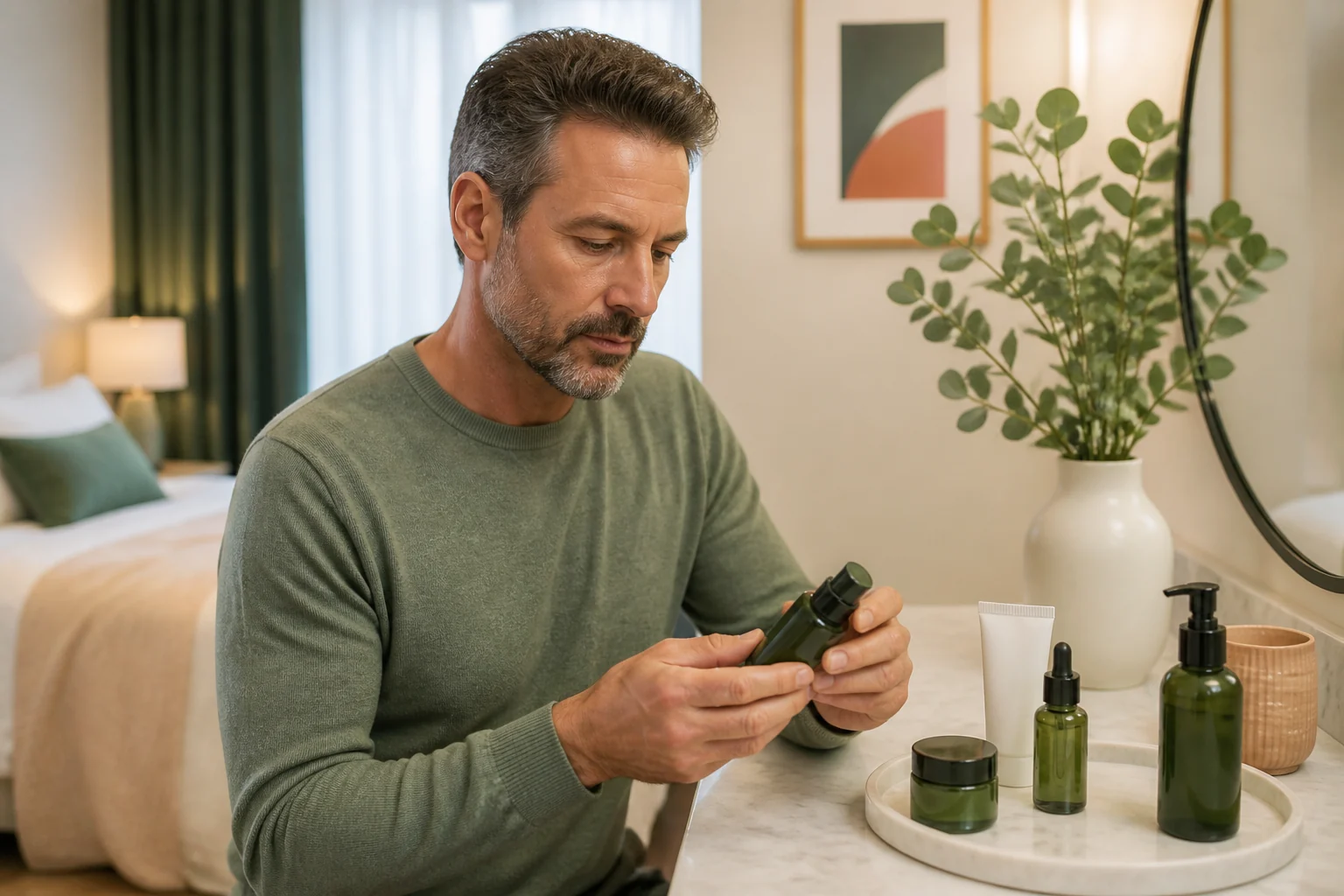
Men’s skin is thicker
Male skin is approximately 25% thicker than female skin on average, primarily due to higher collagen density. This means men’s skin tends to show fine lines less prominently in the early years — but when collagen does start declining (around 40 for most men), the changes can appear more abrupt.
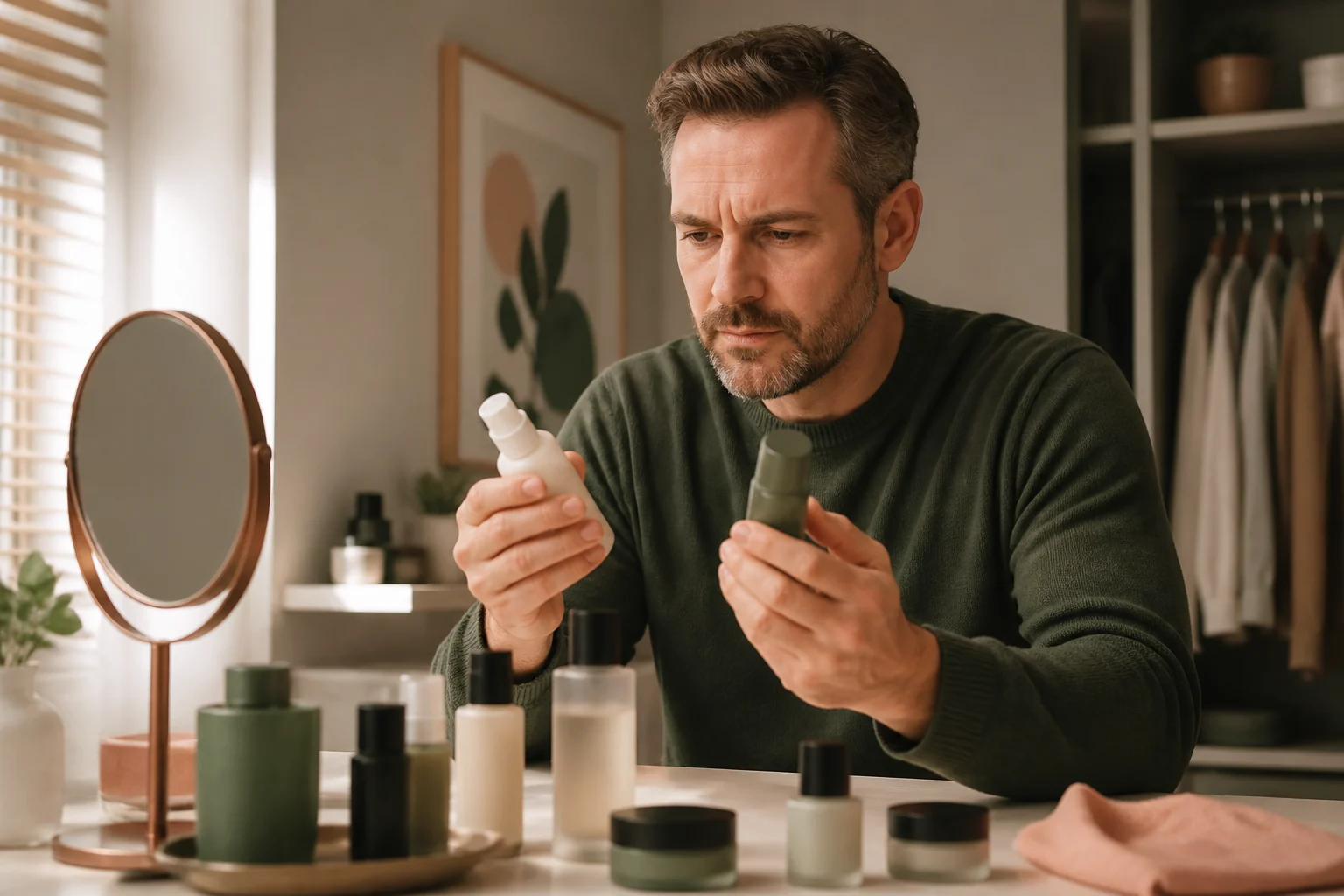
More sebum production
Testosterone drives sebum production, and men typically produce more oil than women at any given age. This continues into the 40s and beyond, though it declines gradually after 50.

Less hydration variation
Men’s skin tends to retain water more consistently than women’s, partly because of higher sebum levels and slightly different ceramide composition.
Cumulative UV damage
Men have historically used less sunscreen than women, leading to significant accumulated UV damage by 40. This shows up as sun spots, mottled pigmentation, and accelerated wrinkling on sun-exposed areas (forehead, ears, neck, hands, scalp for balding men).
Shaving-related changes
Decades of daily shaving create their own skin issues: ingrown hairs, razor burn, post-inflammatory hyperpigmentation, and chronic mild inflammation that can accelerate aging signs in the beard area.
Hormonal changes
Testosterone declines gradually after 30 (about 1% per year). This isn’t dramatic, but combined with cumulative UV damage and other factors, contributes to the changes that show up in the 40s.
What men over 40 actually need
The basic principles for skin care after 40 don’t differ much between men and women. The needs are:
- Cleansing that removes excess oil without stripping the barrier
- Hydration that addresses any tightness or dryness
- Sun protection to prevent further damage
- Active ingredients that address the changes that have already accumulated (lines, sun spots, texture)
The specific products can be different — men often prefer lighter textures, less obvious scents, and quicker routines. But the active ingredients should be the same as what works for any 40-something skin: retinoids, vitamin C, niacinamide, sunscreen, gentle exfoliants.
A baseline routine for men over 40
Three steps for the morning, three for the evening. Total time: under five minutes once you’re used to it.
Morning
- Gentle cleanser. Splash the face with lukewarm water, apply a small amount of gentle face wash, rinse thoroughly, pat dry.
- Moisturizer with SPF (or moisturizer + separate sunscreen). A combined product is the convenient option; separate sunscreen gives you better protection.
- Sunscreen if not in moisturizer. SPF 30+ minimum, applied to entire face, ears, and neck.
Evening
- Cleanser. Same as morning, or slightly stronger if you’ve sweated or worn sunscreen all day.
- Active ingredient. A retinoid (most evidence-supported for visible aging changes) is the best single addition for men over 40. Apply to clean dry skin, wait 15–20 minutes before next step.
- Moisturizer. Helps offset the dryness that comes with active ingredients.
That’s the entire routine. Five products, five minutes, twice a day.
Specific product recommendations
Organized for the man who wants effective products without endless aisle research.
Cleansers
- CeraVe Foaming Facial Cleanser — for normal to oily skin. Contains ceramides and niacinamide, fragrance-free. $15.
- CeraVe Hydrating Facial Cleanser — for dry or sensitive skin. Same brand but without the foaming surfactants. $15.
- La Roche-Posay Toleriane Hydrating Gentle Cleanser — premium-feeling without premium pricing. $17.
- Cetaphil Daily Facial Cleanser — drugstore classic, works fine. $10.
Moisturizers with SPF (combined products for convenience)
- EltaMD UV Daily Tinted SPF 40 — best combined product, lightweight, won’t leave white cast. $35.
- CeraVe AM Facial Moisturizing Lotion SPF 30 — affordable combined product with niacinamide. $16.
- Olay Regenerist Whip SPF 25 — light texture, niacinamide. $30.
Standalone sunscreens (better protection than combined products)
- EltaMD UV Clear SPF 46 — designed for acne-prone skin, contains niacinamide. $40.
- La Roche-Posay Anthelios Melt-In Sunscreen Milk SPF 60 — lightweight, no white cast. $36.
- Black Girl Sunscreen SPF 30 — despite the brand name, works well for all darker skin tones, fully transparent. $19.
Standalone moisturizers (evening)
- CeraVe PM Facial Moisturizing Lotion — affordable, niacinamide + ceramides + hyaluronic acid. $16.
- La Roche-Posay Toleriane Double Repair — slightly more elegant texture. $25.
- Drunk Elephant Protini Polypeptide Cream — premium peptide-rich option. $69.
Active ingredients (the key step for men over 40)
- Differin Gel (adapalene 0.1%) — over-the-counter prescription-level retinoid. Best starting point for men over 40 who haven’t used retinoids before. $15.
- Prescription tretinoin 0.025–0.05% — strongest evidence-supported topical for aging. Ask your dermatologist. Cost varies, often $15–$40 with generic.
- The Ordinary Granactive Retinoid 2% Emulsion — gentler OTC retinoid alternative. $12.
- Olay Regenerist Retinol 24 Night Moisturizer — combines retinol with hydrating actives. $30.
Vitamin C (optional but worthwhile addition)
- Timeless 20% Vitamin C + E + Ferulic Acid Serum — drugstore equivalent of SkinCeuticals C E Ferulic at one-tenth the price. $30.
- The Ordinary Vitamin C Suspension 23% — for men who tolerate stronger products. $15.
- Drunk Elephant C-Firma Day Serum — well-tolerated 15% vitamin C blend. $80.
The single highest-value addition
If you’re going to add only one thing to a basic cleanser-and-sunscreen routine, make it a retinoid. Specifically, Differin Gel (over-the-counter) or prescription tretinoin.
Topical retinoids have decades of clinical evidence for:
- Stimulating collagen production (the primary driver of visible aging changes)
- Reducing fine lines and wrinkles
- Improving skin texture and tone
- Fading sun spots and hyperpigmentation
- Improving skin firmness
This is the single most-supported skincare active for visible aging. Everything else is supporting cast.
How to introduce a retinoid
- Weeks 1–4: 1 night per week. Apply a pea-sized amount to clean, dry face after evening cleanser. Wait 15 minutes, then moisturize.
- Weeks 5–8: 2 nights per week (skip nights between).
- Weeks 9–12: 3 nights per week.
- Months 4+: Nightly if well-tolerated.
Some peeling, dryness, and redness in the first 4–8 weeks is normal. This is “retinization” — your skin adjusting. If it’s severe, slow down. If it’s mild, continue.
Common mistakes
- Applying too much (a pea-sized amount covers the entire face)
- Applying to wet skin (intensifies absorption and irritation)
- Starting too aggressively (causes severe irritation that makes you quit)
- Skipping moisturizer afterward (compounds dryness)
- Skipping sunscreen the next day (retinoid-treated skin is more UV-sensitive)
Shaving and skincare for men over 40
Daily shaving impacts skin and should be considered alongside skincare:
Before shaving
- Use warm water to soften facial hair (warm shower is ideal)
- Apply a generous amount of shaving cream and let it sit for 60+ seconds before shaving
- Use a sharp blade — dull blades require more pressure and cause more irritation
- Shave with the grain (direction of hair growth) for sensitive skin or against the grain for closer shave (more irritation)
After shaving
- Rinse with cool water
- Skip alcohol-based aftershaves — they sting and dry the skin
- Apply a gentle moisturizer or post-shave balm with niacinamide or aloe
- If you use a retinoid in the evening, shave in the morning to avoid combined irritation
For ingrown hairs and razor bumps
- Use a salicylic acid toner or cleanser on the beard area 2–3 times weekly
- Consider an electric razor if you get persistent ingrowns
- For chronic problem, try chemical hair removal products (Magic Shave) instead of blades — common solution for men of color with chronic razor bumps
Hair loss and scalp care
Many men over 40 are dealing with hair changes — thinning, recession, or full pattern hair loss. Some practical points:
- Minoxidil 5% (Rogaine) — slows and partially reverses pattern hair loss. Available OTC. Apply twice daily.
- Finasteride 1mg — oral prescription, more effective than minoxidil for many men, has sexual side effects in a minority of users.
- Scalp sunscreen if you’re balding — easily missed, but the scalp is one of the most UV-exposed areas of skin and develops sun damage quickly.
- Gentle shampoo — daily harsh shampooing can compound hair loss.
For significant hair loss concerns, see a dermatologist for evaluation — there are increasingly effective treatments available.
Common men’s skin concerns
Dark circles under the eyes
Often a combination of genetics, sleep deprivation, alcohol consumption, and natural fat pad depletion under the eyes. Topical caffeine can help temporarily; vitamin C and retinoids over months provide modest improvement. For significant under-eye hollowing, hyaluronic acid filler under the eye is an option to discuss with a dermatologist.
Red, broken capillaries on the nose
Often from sun damage or rosacea. Topical treatments (azelaic acid) help; vascular laser (V-beam, IPL) is the definitive treatment for visible capillaries.
Sun spots on the face, ears, and hands
Use vitamin C in the morning, retinoid at night, daily sunscreen. For established spots, IPL or picosecond laser treatments are effective.
Dull, tired skin appearance
Often improves with consistent use of retinoids and vitamin C over 12+ weeks. Adequate sleep, hydration, and reducing alcohol also help noticeably.
Adult acne / hormonal acne
Less common in men than women but does occur. Adapalene gel (Differin) is the first-line over-the-counter option. For severe cases, see a dermatologist for prescription treatment.
Excessive oil and large-appearing pores
Retinoids gradually reduce pore appearance. Niacinamide 5–10% helps regulate sebum. Salicylic acid 2% cleansers help with congestion.
Dryness in winter
Switch to richer moisturizers in cold weather. CeraVe Moisturizing Cream (in the tub, thicker) instead of the lotion. Hyaluronic acid serums applied to damp skin help significantly.
Routines for specific lifestyles
The minimalist (3 products total)
- Cetaphil Daily Facial Cleanser
- CeraVe AM Facial Moisturizing Lotion SPF 30
- Differin Gel (5 nights per week)
The slightly more invested (5 products total)
- Morning: Cleanser → Vitamin C serum → Moisturizer with SPF
- Evening: Cleanser → Retinoid → Moisturizer
The fully invested (skincare as a hobby)
- Morning: Cleanser → Vitamin C → Niacinamide → Peptide serum → Moisturizer → Mineral sunscreen
- Evening: Double cleanse → Retinoid → Hyaluronic acid → Rich moisturizer → Facial oil
- Weekly: Gentle exfoliation, hydrating mask
Any of these works. The most important thing is consistency.
What’s not worth buying
- “For men” skincare lines that are mostly the same as regular skincare with masculine packaging at higher prices. Read the ingredient list, not the marketing.
- Cologne-scented skincare. Adds irritants without functional benefit.
- “Anti-aging” products with vague active ingredients. If the brand can’t tell you what’s actively doing the work, the active is probably window dressing.
- Charcoal or activated charcoal products marketed as “detoxifying.” Marketing.
- “Snake venom” peptides or similarly exotic ingredients. Marketing.
- Daily exfoliating cleansers with abrasive scrubs. Damage the barrier.
- Facial cleansing brushes (Clarisonic-style). Generally too aggressive for adult skin.
Frequently asked questions
Do I need separate “men’s” products?
Not really. The biological differences between men’s and women’s skin are small enough that products formulated for either sex work for both. “Men’s” products are usually identical to unisex products with different marketing. Read the ingredient list and pick what works.
I’ve never used skincare before. Where do I start?
Cleanser, moisturizer with SPF, retinoid (start gradually). That’s the foundation. You can add vitamin C and other actives later if you want, but the basic three will produce real improvement within a few months.
Is it too late to start at 50?
No. Skin responds to good care at any age. Topical retinoids have shown improvements in subjects starting at any adult age, including 60s and 70s. The improvements you see may be more gradual than they would have been at 30, but they’re real and meaningful.
How long until I see results?
Hydration improvements: 2–4 weeks. Better tone and brightness: 6–8 weeks. Visible fine line improvement: 12–16 weeks. Substantial improvement requires 6+ months of consistent use.
What about treatments at a dermatologist’s office?
For men over 40 with established concerns, in-office treatments add what topicals can’t reach:
- Botox for forehead lines and crow’s feet
- IPL for sun spots and broken capillaries
- Microneedling or fractional laser for texture
- Filler for under-eye hollowing or volume loss
These are increasingly common among men. Many men start with retinoid + sunscreen at home and add 1–2 in-office treatments per year for compounding effect.
Will skincare make me look feminine?
Modern skincare is broadly unisex. The products that work for men’s skin care are largely the same as for women’s. You won’t smell perfumed, you won’t have shiny skin, you won’t look like you’re “trying.” You’ll look like a man whose skin has been taken care of — which is the goal.
When to see a dermatologist
- Any new or changing mole (annual skin checks become important after 40)
- Persistent acne not responding to OTC treatment
- Significant hair loss you’d like evaluated
- Sun spots or hyperpigmentation that bothers you (in-office treatment is highly effective)
- Interest in prescription retinoids or other treatments
- Suspected rosacea, eczema, or other skin conditions
- Sun-damaged areas that warrant skin cancer screening
The bottom line
Skincare for men over 40 isn’t complicated. The most important changes — visible aging, sun damage, declining elasticity — respond best to:
- Daily sunscreen (the single highest-value habit)
- A nightly retinoid (the single highest-value active ingredient)
- A consistent moisturizer that supports the barrier
Add vitamin C in the morning and niacinamide if you want more. Skip the bro-marketing and trendy ingredients. Stick with a simple routine for 12+ weeks and you’ll see real, visible change.
The men who age best aren’t doing anything dramatic. They’re doing a few sensible things every day for years. The compounding is what matters.