
Editorial note: This article is for general skincare education only. It does not diagnose, treat, or replace advice from a dermatologist, OB-GYN, or other licensed clinician. If you are pregnant, breastfeeding, using prescription medications, or dealing with persistent or severe symptoms, confirm product and ingredient choices with your healthcare provider.
Ceramides are having a long, well-deserved moment in skincare. They show up in almost every barrier-repair product, get name-dropped by dermatologists, and form the foundation of brands like CeraVe (the name is literally “Cer” + “Ve” for vitamins). The reason: ceramides are one of the genuinely best-studied ingredients in skincare, with clinical evidence backing their barrier-repair effects.
The catch: not every product labeled “ceramide” actually delivers meaningful amounts. Here’s how to pick one that does.
What ceramides actually are
Ceramides are lipids — specifically, a family of fatty molecules — that form a critical part of your skin’s outermost protective layer. Dermatologists call that layer the stratum corneum, which is a fancy way of saying “the dead-cell barrier on top of your skin that keeps water in and irritants out.”
Think of the stratum corneum like a brick wall:
- The bricks are flattened dead skin cells (corneocytes)
- The mortar between them is a precise mixture of three lipid types: ceramides (about 50% of the mortar), cholesterol (25%), and fatty acids (15%)
When this mortar is intact and complete, water stays inside your skin (which keeps it plump and comfortable) and irritants stay outside (which keeps your skin calm and non-reactive). When the mortar is depleted or in the wrong ratio, water escapes (skin feels tight and dry), and irritants get through (skin becomes sensitive, reactive, sometimes red and inflamed).
This depletion is what dermatologists mean when they talk about “compromised skin barrier.”
Who has compromised ceramide levels
Lots of people. The conditions that strip ceramides from your skin barrier:

- Eczema (atopic dermatitis) — most clearly documented case. Eczema-prone skin has measurably lower ceramide levels than non-eczema skin.
- Aging — ceramide production declines with age, particularly after menopause. Most women over 50 have significantly lower ceramide levels than they did at 30.
- Rosacea — barrier dysfunction is a core feature of rosacea, including ceramide depletion.
- Acne — counterintuitive, but acne-prone skin often has reduced ceramide production. The harsh products commonly used to manage acne-prone skin (benzoyl peroxide, salicylic acid, retinoids) further deplete it.
- Psoriasis — similar to eczema in terms of barrier dysfunction.
- Cold/dry climates — winter dryness strips ceramides faster than they can be replaced.
- Over-cleansing — harsh cleansers, hot water, washing too frequently all deplete skin lipids including ceramides.
- Use of active ingredients — retinoids, AHAs, BHAs, and vitamin C can temporarily reduce ceramide levels by accelerating turnover.
- Postpartum hormonal shifts — many women experience temporary barrier dysfunction in the first 12 months after delivery.
If any of these apply to you, you’re a strong candidate for ceramide-rich skincare.
What ceramides do in a moisturizer
Topical ceramides applied in a moisturizer do two things:
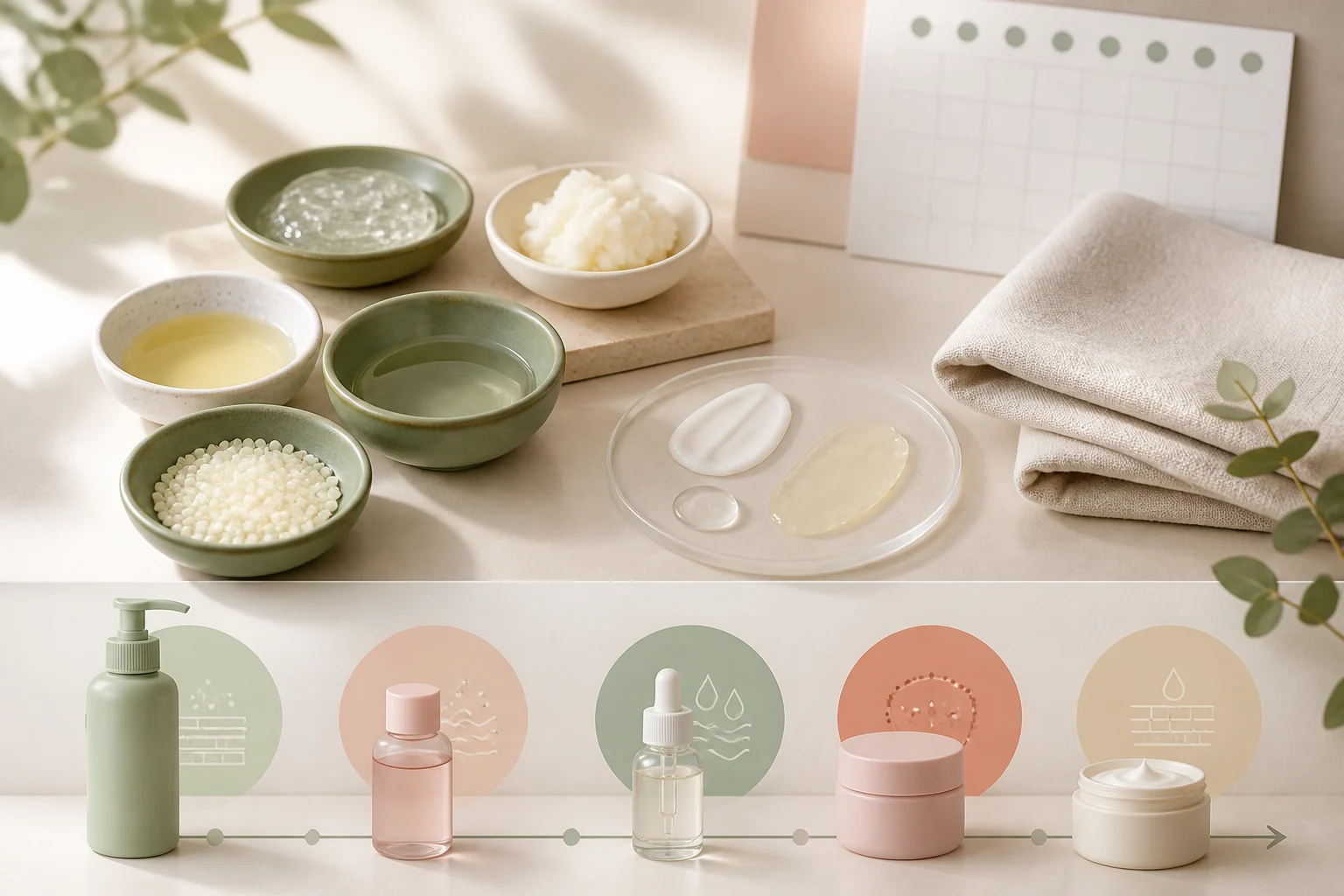
They directly replace what’s missing in the barrier. The ceramides in your moisturizer integrate into your stratum corneum and fill in the gaps in the “mortar between the bricks.” This is unusual in skincare — most ingredients signal your skin to do something; ceramides physically substitute for missing material.
They signal your skin to produce more of its own. Topical ceramides also seem to upregulate your skin’s natural ceramide synthesis over time. This means consistent ceramide moisturizer use can have lasting effects beyond the duration of any individual application.
The combination produces measurable improvements in barrier function — reduced transepidermal water loss (skin holds water better), reduced reactivity to irritants, less visible redness, less peeling and flaking.
Which ceramides matter
Skincare ingredient lists name ceramides with confusing chemistry-class nomenclature. The most important ones in cosmetic formulations:
- Ceramide NP (formerly ceramide 3) — the most-studied, most common in skincare. Effective barrier replenisher.
- Ceramide AP (formerly ceramide 6-II) — antioxidant properties in addition to barrier function.
- Ceramide EOP (formerly ceramide 1) — important for barrier organization, less common in products.
- Phytosphingosine — a ceramide precursor; skin converts it into functional ceramides.
- Sphingolipids — broader family of lipids that includes ceramides.
The best products contain a mix of multiple ceramides because the skin’s natural barrier uses many forms together. Single-ceramide formulations are less complete.
What else makes a ceramide moisturizer work
Ceramides alone are less effective than ceramides combined with the other barrier lipids. Look for products that include:
- Cholesterol — the second-most-abundant barrier lipid. Best products include it explicitly.
- Fatty acids (linoleic acid, oleic acid, palmitic acid) — the third leg of the barrier lipid trio.
- Hyaluronic acid — pulls water into the barrier; ceramides keep it there.
- Niacinamide — stimulates the skin’s own ceramide production from within.
- Glycerin — basic but essential humectant.
A product with ceramides PLUS cholesterol PLUS fatty acids PLUS niacinamide is dramatically more effective than a product with ceramides alone.
Best ceramide moisturizers by category
Drugstore (under $20)
- CeraVe Moisturizing Cream ($18) — the reference standard. Ceramides 1, 3, and 6-II plus hyaluronic acid in a substantial cream texture. Best for very dry or compromised skin.
- CeraVe PM Facial Moisturizing Lotion ($16) — lighter texture, adds niacinamide. Excellent night moisturizer.
- CeraVe AM Facial Moisturizing Lotion with SPF 30 ($16) — same ceramide complex plus daily sunscreen.
- Eucerin Original Healing Cream ($14) — petroleum-based occlusive cream. Less elegant than CeraVe but powerful for very dry, cracked skin.
Mid-tier ($20-50)
- La Roche-Posay Toleriane Double Repair Face Moisturizer ($25) — niacinamide-prebiotic-ceramide complex. Lighter than CeraVe Cream, better for daytime under makeup.
- First Aid Beauty Ultra Repair Cream ($38) — colloidal oatmeal plus ceramides plus shea butter. Multi-purpose, well-tolerated by reactive skin.
- Drunk Elephant Lala Retro Whipped Cream ($60) — six African oils plus ceramides. Heavier, occlusive feel.
- Paula’s Choice Resist Barrier Repair Moisturizer ($36) — ceramides plus antioxidants, lightweight texture.
Premium ($50+)
- EltaMD Barrier Renewal Complex ($65) — peptides plus ceramides plus enzymes. Comprehensive formulation.
- iS Clinical Reparative Moisture Emulsion ($80) — premium pharmacy brand, well-formulated.
- SkinCeuticals Triple Lipid Restore 2:4:2 ($140) — the most-researched premium option. Contains ceramides, cholesterol, and fatty acids in the specific 2:4:2 ratio that researchers have identified as optimal for barrier repair. Worth the price if you have significant barrier dysfunction.
- Avene RetrinAL Eyes ($80) — for the eye area, ceramides plus gentle retinaldehyde.
K-beauty options
Korean skincare has historically emphasized barrier health, and many K-beauty products contain ceramides at meaningful concentrations:
- Dr.Jart+ Ceramidin Cream ($45) — premium K-beauty option, multiple ceramide types.
- Etude House Soon Jung 2X Barrier Intensive Cream ($22) — gentle ceramide-rich formulation for sensitive skin.
- Beauty of Joseon Glow Deep Serum ($17) — contains ceramides plus rice extract and alpha arbutin.
For oily or acne-prone skin
Yes, oily skin needs ceramides too. The lightweight options:
- CeraVe PM Facial Moisturizing Lotion ($16) — lighter than the cream, suitable for combination/oily skin.
- The Ordinary Natural Moisturizing Factors + HA ($9) — includes ceramides and amino acids. Light gel texture.
- Krave Beauty Oat So Simple Water Cream ($28) — minimal ingredients including ceramides, suitable for oilier skin.
How to use ceramide moisturizer effectively
Application technique
- Apply to slightly damp skin. Ceramides absorb better and form a more cohesive barrier when applied within 1-2 minutes of cleansing.
- Use enough. A pea-sized amount isn’t enough for ceramide moisturizers — they’re designed for relatively generous application. A nickel-sized amount for the face is reasonable.
- Apply with patting motions, not aggressive rubbing. The goal is to spread evenly without disturbing the existing skin lipids.
- Layer with serums. Apply your serums first (vitamin C, niacinamide, hyaluronic acid), then ceramide moisturizer over the top. Ceramides work best as the moisturizer step in your routine.
How often
Twice daily for most users dealing with barrier dysfunction. Once daily (evening) is sufficient for maintenance use. Some users with severely compromised skin benefit from a third midday application during winter.
How long until you see results
Acute barrier dysfunction (red, stinging skin from a recent product reaction or harsh treatment) typically improves visibly within 5-7 days of consistent ceramide moisturizer use.
Chronic barrier issues (long-term dryness, persistent reactivity) take longer — 4-8 weeks of consistent twice-daily use before substantial improvement.
Anti-aging and overall skin quality benefits compound over months. Year-long users typically have measurably better-looking, calmer skin than they had before starting.
Common mistakes
- Using ceramide moisturizer occasionally rather than daily. The barrier needs ongoing maintenance. Sporadic use doesn’t accumulate benefit.
- Applying over dry skin. Reduces effectiveness significantly. Apply within 1-2 minutes of cleansing.
- Skipping the sunscreen step. Daytime ceramide moisturizers without SPF protection leave skin barrier-fortified but UV-vulnerable.
- Using too little. Ceramide products are formulated for generous application; tiny amounts don’t deliver enough material to make a difference.
- Pairing with harsh actives without barrier support. Using ceramide moisturizer at night while using stripping cleansers and high-percentage acids in the morning cancels out the benefit.
Frequently asked questions
Can I use ceramide moisturizer with retinol?
Yes — they’re complementary. Apply retinol first to dry skin, then ceramide moisturizer over the top. The ceramide moisturizer reduces retinol-induced irritation while still allowing retinol to work.
Do I need a serum AND a ceramide moisturizer?
Not necessarily. If your skin barrier is your primary concern, a good ceramide moisturizer can carry the routine on its own (plus cleanser and sunscreen). If you have additional concerns (hyperpigmentation, fine lines, acne), serums target those while ceramide moisturizer maintains barrier health.
Will ceramide moisturizer make my skin oily?
Counterintuitively, no — and often the opposite. Many people with “oily skin” are actually dehydrated, with overactive sebum production compensating for a damaged barrier. Restoring the barrier (with ceramides) often reduces oiliness over 4-8 weeks.
Can I use ceramide moisturizer during pregnancy?
Yes. Ceramides are commonly discussed as lower-risk during pregnancy, but confirm with your clinician and especially valuable during pregnancy when skin is more reactive. Look for products without retinoids or high-strength salicylic acid.
Is one ceramide product better than another?
Within the well-formulated category, the differences are modest. CeraVe Moisturizing Cream ($18), La Roche-Posay Toleriane Double Repair ($25), and First Aid Beauty Ultra Repair Cream ($38) are all effective. The premium SkinCeuticals Triple Lipid Restore ($140) has the most precisely-calibrated formulation if you want optimal barrier repair, but for most users the drugstore options are excellent value.
How do I know if my ceramide moisturizer is working?
Signs of improving barrier function: reduced post-wash tightness, less reactivity to other products, fewer dry patches, less redness over time, skin that “looks healthier” without specifically being able to name why. These improvements compound over months.
Can I make my own ceramide moisturizer?
No. Cosmetic-grade ceramides require specific formulation chemistry to be stable and bioavailable. DIY ceramide products almost never deliver functional ceramides. Stick with commercial formulations.
When to see a dermatologist
- Persistent eczema or psoriasis flares despite daily ceramide moisturizer use — may need prescription topical steroids or barrier-targeted prescription products
- Severe sensitivity that doesn’t improve after 4-8 weeks of consistent ceramide use
- Suspected contact dermatitis to specific ingredients — patch testing can identify culprits
- Rosacea symptoms that need pharmaceutical intervention (azelaic acid prescription, doxycycline, isotretinoin for severe cases)
The bottom line
Ceramides are one of the genuinely best-studied, most-reliable ingredients in skincare. If your skin is dry, sensitive, reactive, aging, eczema-prone, or recovering from product-induced damage, a ceramide-based moisturizer is one of the most useful single products you can add to your routine.
The best value picks for most users: CeraVe Moisturizing Cream ($18) for dry skin, CeraVe PM Lotion ($16) for normal to combination, La Roche-Posay Toleriane Double Repair ($25) if you want something a bit more elegant. The premium SkinCeuticals Triple Lipid Restore ($140) is worth it for users with significant barrier dysfunction who can afford the price.
Apply twice daily, generously, on slightly damp skin, for at least 4-8 weeks before evaluating results. Most users see meaningful improvement in the first month and substantial benefits by month three. Once established in your routine, ceramide moisturizer becomes one of those unglamorous, foundational products that quietly makes everything else work better.