
Editorial note: This article is for general skincare education only. It does not diagnose, treat, or replace advice from a dermatologist, OB-GYN, or other licensed clinician. If you are pregnant, breastfeeding, using prescription medications, or dealing with persistent or severe symptoms, confirm product and ingredient choices with your healthcare provider.
By the time you’ve reached menopause — officially, 12 consecutive months without a period — your skin has been changing for years. Estrogen production has dropped to roughly 10% of premenopausal levels. The skincare routine that worked in your 30s feels insufficient. The one that worked in early perimenopause has been outgrown.
Menopausal skin needs a different approach. Here’s what works.
What menopause does to skin
Estrogen has been one of your skin’s most important hormones since puberty. It drives:
- Collagen production
- Hyaluronic acid synthesis
- Sebum production (in balance with androgens)
- Skin thickness and density
- Wound healing and recovery
- Barrier lipid production
When estrogen drops to postmenopausal levels, all of these functions decline. The cumulative effect over 5–10 years post-menopause is significant:
- Collagen loss: roughly 30% in the first 5 years post-menopause, 1–2% per year afterward
- Skin thickness: measurable thinning of both epidermis and dermis
- Dryness: persistent, often severe; the moisturizer that worked at 50 feels inadequate at 58
- Sagging: particularly along the jawline, cheeks, and around the eyes
- Hyperpigmentation: sun spots become more prominent; new ones appear
- Sensitivity: skin becomes more reactive; products that never bothered you may now sting
- Slowed healing: minor cuts and breakouts take longer to resolve
None of this is reversible to the state of your 30s. But all of it can be substantially improved with the right routine and the right treatments.
The principles of menopausal skincare
Hydrate more than seems necessary
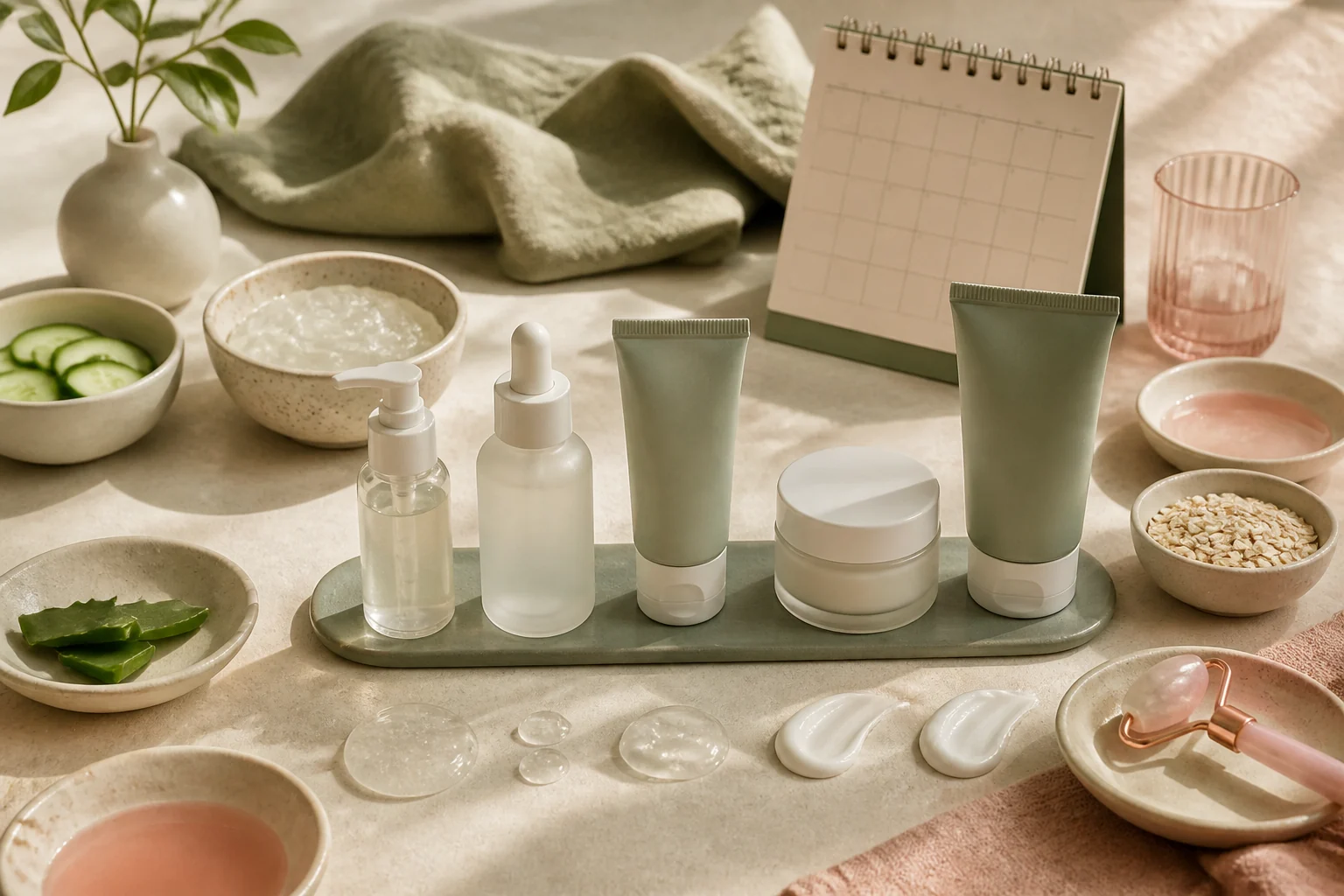
Menopausal skin loses water faster than it used to. Layered hydration — hyaluronic acid serum on damp skin, ceramide moisturizer over the top, optional facial oil as a final occlusive — does more than any single product.
Build collagen actively
Retinoids are especially important for menopausal skin if you can tolerate them. They’re the most effective topical for stimulating collagen production, which is exactly what menopausal skin needs.
Strict sun protection, especially now
Cumulative UV damage shows up dramatically in menopausal skin because the underlying tissue is more vulnerable. Daily, generous, mineral sunscreen is essential. Sun protection has more impact at 60 than at 30 because the skin’s recovery capacity is reduced.
Address pigmentation aggressively
Sun spots, melasma, and post-inflammatory hyperpigmentation accumulate and become harder to fade with age. A multi-active approach (vitamin C, niacinamide, azelaic acid, prescription hydroquinone or tretinoin) is often necessary for visible results.
Be gentle, but not passive
The temptation with mature skin is to do less and avoid stronger actives out of fear. But mature skin often benefits from more active ingredients — applied more gently and patiently. Avoiding retinoids in your 60s is leaving your most effective tool on the table.
Sleep, hydration, protein still matter
Lifestyle factors that always mattered for skin matter more now, when the skin’s resilience is lower.
The cornerstones of menopausal skincare
Retinoid
Prescription tretinoin (0.025–0.05%) or adapalene is the gold standard. Over-the-counter retinols (0.3–1.0%) are reasonable alternatives if prescription isn’t accessible. Bakuchiol is a gentler alternative for women who can’t tolerate retinoids.
For menopausal skin, the introduction protocol should be especially gradual:
- Weeks 1–4: 1 night per week
- Weeks 5–8: 2 nights per week
- Weeks 9–12: every other night
- Months 3–6: 3–5 nights per week, building toward nightly
Always apply to dry skin (wet skin amplifies absorption and irritation), wait 15–20 minutes, then layer moisturizer.
Vitamin C — morning
Topical vitamin C in L-ascorbic acid form (10–20%) is the standard morning antioxidant. For sensitive menopausal skin, gentler derivatives (tetrahexyldecyl ascorbate, magnesium ascorbyl phosphate, ascorbyl glucoside) work nearly as well with less stinging.
Niacinamide
2–10% niacinamide reduces inflammation, supports the barrier, helps with hyperpigmentation, and works well in any routine. Easy to add via a moisturizer that contains it, or as a separate serum.
Ceramide-rich moisturizer (twice daily, generously)
This is the foundation. Menopausal skin needs more ceramide replacement than younger skin. The SkinCeuticals Triple Lipid Restore 2:4:2 is specifically formulated for postmenopausal skin and has clinical research behind it. CeraVe Moisturizing Cream is the drugstore equivalent at one-tenth the price.
Hyaluronic acid serum (applied to damp skin)
Topical hyaluronic acid partially compensates for the decline in skin’s own hyaluronic acid production. Apply to slightly damp skin — wet hyaluronic acid pulls water in; dry hyaluronic acid can pull water OUT of the skin in dry conditions.
Peptides
Specific peptides (Matrixyl, copper peptides, palmitoyl peptides) have clinical evidence for supporting collagen and skin firmness. Peptide serums or moisturizers add modest but real benefit. They’re not a substitute for retinoids, but they complement them.
Daily mineral sunscreen
Mineral sunscreens (zinc oxide, titanium dioxide) are preferable to chemical for menopausal skin because the latter often stings. Tinted mineral sunscreens provide visible-light protection that helps with developing hyperpigmentation.
A complete menopausal routine
Morning
- Splash with cool water or use a very gentle cream cleanser
- Vitamin C serum (10–20%, or gentler derivative)
- Niacinamide serum if not in your moisturizer (5–10%)
- Peptide serum if using one (Drunk Elephant Protini, Olay Regenerist Micro-Sculpting Serum, etc.)
- Hyaluronic acid serum on damp skin
- Rich ceramide moisturizer — apply generously
- Tinted mineral sunscreen SPF 30+
Evening
- Double cleanse if wearing makeup or SPF (oil cleanser first, then gentle water-based)
- Retinoid (prescription tretinoin or OTC retinol) on dry skin
- Wait 15–20 minutes
- Hyaluronic acid serum on damp skin (light spritz of water if needed)
- Rich night cream — possibly thicker than morning moisturizer
- Facial oil as final occlusive (squalane, marula, rosehip)
Weekly additions
- 1 night per week: gentle exfoliating toner (lactic acid 5–7%) or hydroxyacid pads — skip the night you use retinoid
- 2–3 nights per week: hydrating sheet mask or rich overnight mask in place of regular moisturizer
- 1 night per week: skip the retinoid entirely; let skin rest
Specific product recommendations for menopausal skin
Cleansers
- CeraVe Hydrating Facial Cleanser — drugstore staple
- La Roche-Posay Toleriane Hydrating Gentle Cleanser — slightly more elegant
- Avene Tolerance Extreme Cleansing Lotion — for very reactive postmenopausal skin
- SkinCeuticals Gentle Cleanser — premium option, glycerin-rich
Vitamin C serums
- SkinCeuticals C E Ferulic — clinical gold standard, expensive but proven
- Timeless 20% Vitamin C + E Ferulic Acid — drugstore alternative with similar formula at much lower cost
- Drunk Elephant C-Firma Day Serum — mid-tier, well-tolerated
- The Ordinary Vitamin C Suspension 23% — for those who tolerate it well
Retinoids
- Prescription tretinoin 0.025% or 0.05% — the gold standard. Ask your dermatologist.
- Differin (adapalene 0.1%) — over-the-counter prescription-level option, gentler than tretinoin
- SkinCeuticals Retinol 0.5% — well-formulated OTC, less irritating
- Olay Regenerist Retinol 24 — drugstore option with niacinamide
- Bakuchiol-based products — Herbivore, Versed, Biossance — for those who can’t tolerate retinoids
Moisturizers
- SkinCeuticals Triple Lipid Restore 2:4:2 — clinical-grade ceramide and lipid replacement specifically researched for postmenopausal skin
- CeraVe Moisturizing Cream — drugstore alternative
- EltaMD Barrier Renewal Complex — peptides + ceramides
- La Mer Crème de la Mer — luxury positioning; whether the science justifies the price is debatable
- Augustinus Bader The Cream — premium peptide-rich
- Dr. Barbara Sturm Face Cream — premium peptide and antioxidant-rich
Sunscreens
- EltaMD UV Elements Tinted SPF 44 — mineral, tinted, dermatologist-favorite
- Colorescience Total Protection Face Shield SPF 50 — premium mineral with iron oxides
- Tower 28 SunnyDays Tinted SPF 30 — newer favorite
- La Roche-Posay Anthelios Mineral SPF 50 — affordable
In-office treatments worth considering
Topicals can only do so much for established menopausal changes. In-office treatments fill the gap.
For texture and fine lines
- Microneedling — creates microinjuries that stimulate collagen production. Series of 3–6 treatments produces visible change.
- Fractional non-ablative laser (Fraxel) — improves texture, fine lines, and pigmentation simultaneously. Multiple sessions needed.
- Chemical peels — modified Jessner’s, TCA peels can dramatically improve mature skin surface
For hyperpigmentation
- IPL (intense pulsed light) — excellent for sun spots and overall pigmentation evening
- Picosecond laser (PicoSure, PicoWay) — newer technology, very effective for stubborn pigmentation
For firmness and lifting
- Ultherapy — ultrasound-based skin tightening, especially for jawline
- Morpheus8 — radiofrequency microneedling, addresses both texture and firmness
- Thermage — radiofrequency tightening
For volume
- Hyaluronic acid fillers — restore volume in cheeks, temples, nasolabial folds, lips. The trend is toward subtle, gradual filler rather than dramatic changes.
- Sculptra (poly-L-lactic acid) — stimulates the body’s own collagen, gradual results over months
For dynamic wrinkles
- Neuromodulators (Botox, Dysport, Xeomin) — for forehead lines, crow’s feet, the 11s
Lifestyle factors that matter more now
- Hormone replacement therapy (HRT) discussion with your provider. Skin benefits aren’t usually the reason for HRT, but they’re a real ancillary effect. Worth informed conversation about risks and benefits.
- Strict sun avoidance, not just sunscreen. Hats, sunglasses, indoor activities during peak UV hours.
- Strength training. Resistance exercise affects collagen synthesis systemically, in addition to its other benefits during menopause (bone density, muscle mass).
- Protein intake. Postmenopausal women often eat less than they realize. Adequate protein (1.0–1.2 g/kg of body weight daily) supports skin and overall tissue.
- Sleep. Skin repairs during deep sleep. Menopausal sleep disruption affects skin within weeks.
- Reduced alcohol. Alcohol metabolism slows; skin reactivity to alcohol increases.
Frequently asked questions
Is it too late to start retinol in my 60s?
No. Studies have shown improvements in skin texture, fine lines, and elasticity from retinoid use started in the 60s and even 70s. Start more gradually than you would have at 40, but start.
Do I need a different routine for nighttime vs daytime?
Yes. Morning is about protection (vitamin C, sunscreen, hydration). Evening is about repair (retinoid, peptides, rich moisturizer). The asymmetry matters.
What about facial oils?
Facial oils work well for menopausal skin as a final occlusive step. Squalane is the most neutral; marula and rosehip add additional benefits. Avoid oils with fragrance or essential oils.
Can I do everything at home, or do I need a dermatologist?
You can manage most things at home with a good topical routine and discipline. But in-office treatments (lasers, fillers, peels) can produce results that topicals can’t. Most women see benefit from at least an annual dermatology visit for evaluation and treatment planning.
Is mineral makeup better for menopausal skin?
Generally yes — mineral foundations and powders contain fewer potential irritants than traditional liquid foundations. Brands like Jane Iredale, BareMinerals, and IT Cosmetics are widely well-tolerated.
The bottom line
Menopausal skin needs more than you used to give it. More hydration, more retinoid (with patience), more peptides, more sun protection, more layering. The good news is that mature skin is genuinely responsive to good care — you’ll see and feel the improvements within 12 weeks of a thoughtful routine, with continued progress over 6–12 months.
Don’t try to recreate the skin of your 30s. Aim for the best version of the skin you have now: nourished, calm, well-protected, and visibly cared for. That’s an achievable and worthwhile goal at any age.