Editorial note: This article is for general skincare education only. It does not diagnose, treat, or replace advice from a dermatologist, OB-GYN, or other licensed clinician. If you are pregnant, breastfeeding, using prescription medications, or dealing with persistent or severe symptoms, confirm product and ingredient choices with your healthcare provider.
Rosacea is one of the most misunderstood skin conditions adult women face. It’s often dismissed as “sensitive skin” by people who don’t have it. It’s frequently mistaken as adult acne, which leads women to use treatments that make rosacea more irritated. And the routines that work for it look nothing like the routines that work for normal skin.
If you have rosacea — or if you suspect you do — this guide can give you a more cautious starting point.
What rosacea actually is
Rosacea is a chronic inflammatory skin condition characterized by:
- Persistent redness on the central face (cheeks, nose, forehead, chin)
- Visible small blood vessels (telangiectasia)
- Flushing — episodes of intense temporary redness
- In some subtypes, small acne-like papules and pustules
- Often a burning, stinging, or tight sensation
- Increased reactivity to products, weather, food, and stress
It’s not acne, though the bumps can look similar (and the conditions can coexist). It’s not simply “sensitive skin,” though it includes sensitivity. It’s an inflammatory condition with a strong vascular component and often a connection to the skin microbiome.
The American Academy of Dermatology recognizes four major subtypes:
- Erythematotelangiectatic rosacea (ETR) — flushing and persistent redness, sometimes with visible capillaries. No papules. The most common adult-woman pattern.
- Papulopustular rosacea — redness plus inflammatory bumps that look like acne. Often the type most mistaken.
- Phymatous rosacea — thickening of the skin, especially on the nose. More common in men.
- Ocular rosacea — affecting the eyes, with dryness, burning, and inflamed eyelids. Easy to miss but important to identify.
Many women have features of more than one subtype. The condition tends to wax and wane over years.
What triggers a rosacea flare
Understanding triggers is half the battle. Common ones include:
- Sun exposure (the most universal trigger)
- Heat — hot showers, hot weather, saunas, exercise in hot conditions
- Spicy foods
- Alcohol, especially red wine
- Stress and emotional reactivity
- Wind and cold (paradoxically — extremes in either direction)
- Skincare products with alcohol, fragrance, menthol, eucalyptus, peppermint, witch hazel
- Hot beverages
- Certain medications (niacin, blood pressure drugs that cause flushing)
- Hormonal shifts, including pregnancy and perimenopause
Identifying your specific triggers is more useful than avoiding all possible triggers (which becomes impractical). Many women keep a flare diary for a few weeks to pattern-match.
The general principles of rosacea-friendly skincare
Before product recommendations, the principles:
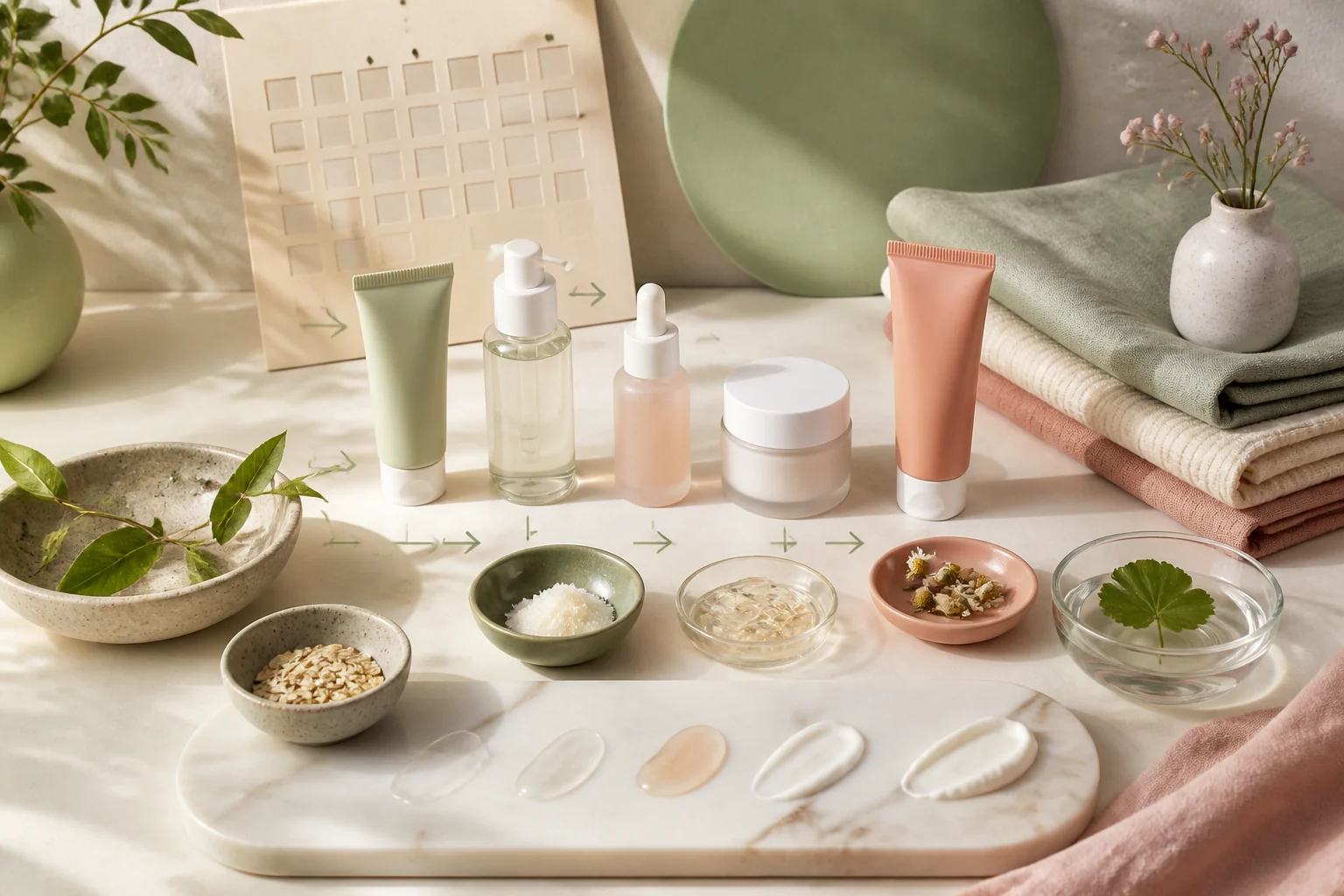
Less is more
The single most common mistake in rosacea care is doing too much. Multiple actives, exfoliants, fancy serums, layered acids — these are all anti-rosacea routines. The simpler your routine, the better-behaved your skin.
A working rosacea routine often has 3–4 products total: cleanser, treatment, moisturizer, sunscreen. That’s it.
Skin barrier support, not stripping
Rosacea skin has a compromised barrier function — water loss is higher than in normal skin, and protective lipid composition is altered. The goal is to support and rebuild the barrier, not to exfoliate or “deep clean” through it.
This means: gentle cleansers, ceramide-rich moisturizers, no foaming sulfate cleansers, no daily acids, no scrubs.
Cool, not hot
Use lukewarm or cool water on your face. Avoid hot showers reaching the face. Avoid washcloths or aggressive rubbing. Pat dry, never scrub.
Sun protection is especially important
UV is the most reliable rosacea trigger. Daily mineral sunscreen — not chemical (which can sting and exacerbate redness in rosacea skin), not heavy lotion (which can occlude inflammation). Mineral, ideally tinted, every morning.
Ingredients that help rosacea
Azelaic acid 15% (often prescription)
Azelaic acid is one of the few skincare ingredients with strong clinical evidence specifically for rosacea. It reduces redness, anti-inflammatory effects, and is gentle enough that rosacea skin generally tolerates it. The 15% prescription gel (Finacea) is FDA-approved for rosacea treatment. The 10% over-the-counter version is a reasonable starting point.
Niacinamide 4–10%
Niacinamide reduces redness, supports the skin barrier, has anti-inflammatory effects, and reduces sebum. It’s tolerated by nearly everyone, including the most reactive skin. The Ordinary 10% is the standard cheap pick; many gentler moisturizers contain niacinamide.
Centella asiatica (Cica)
Also called gotu kola or tiger grass. Centella has anti-inflammatory, antioxidant, and wound-healing properties. Studies in rosacea-prone and sensitive skin have shown meaningful reduction in redness and improved barrier function. It’s a staple of K-beauty calming routines for good reason.
Ceramides
Ceramides are lipids that make up much of the skin barrier. Topical ceramide products replenish this lipid layer, reducing water loss and reactivity. Look for products listing ceramide NP, ceramide AP, or ceramide EOP in the ingredient deck.
Sulfur (in lotions, not soaps)
For rosacea with inflammatory papules, sulfur lotions and sulfur-containing cleansers (Plexion, Sumadan, Avene Cleanance) have decades of use as a gentle antimicrobial. Less drying than benzoyl peroxide, less irritating than salicylic acid.
Ivermectin 1% (prescription)
For papulopustular rosacea specifically. Ivermectin reduces Demodex mite populations, which are now understood to be involved in inflammatory rosacea. Brand name Soolantra. Prescription-only and worth asking your dermatologist about.
Brimonidine (prescription, for flushing)
A topical gel that constricts blood vessels in the skin, reducing visible flushing. Brand name Mirvaso. Useful for episodic intense flushing; not a treatment for the underlying condition.
Ingredients to avoid
The list of things that make rosacea worse is longer than the list of helps. The major categories:
- Alcohol-based products — toners, “refreshing” mists, anything with denatured alcohol (alcohol denat, SD alcohol) high in the ingredient list
- Fragrance — both synthetic fragrance (“parfum”) and essential oils. Even “natural” fragrances are a major trigger.
- Menthol, peppermint, eucalyptus, camphor — anything that creates a tingling or cooling sensation
- Witch hazel — astringent, often alcohol-extracted
- Strong physical exfoliants — scrubs with apricot kernels, walnut shells, sugar crystals
- Acids in high concentrations — glycolic, lactic, salicylic above 2%, mandelic at high doses, AHA peels
- Retinoids in standard concentrations — even prescription retinoids can be tolerated but require very slow introduction; over-the-counter retinols often flare rosacea
- Benzoyl peroxide — too harsh for most rosacea skin
- Sulfates in cleansers — sodium lauryl sulfate, sodium laureth sulfate
- Drying clays — kaolin, bentonite at high concentrations
A baseline rosacea routine
Morning
- Rinse with cool water only, or use a gentle cream cleanser if you wear sunscreen and makeup overnight (rare). Many rosacea sufferers do best skipping the morning cleanse entirely.
- Niacinamide serum (5–10%) for general inflammation reduction
- Moisturizer with ceramides (CeraVe Moisturizing Cream, La Roche-Posay Toleriane Double Repair, Cetaphil Moisturizing Cream)
- Tinted mineral sunscreen SPF 30+ — the tint matters because iron oxides reduce flushing visibility and protect against visible light
Evening
- Gentle cream cleanser — CeraVe Hydrating Cleanser, La Roche-Posay Toleriane Hydrating, Bioderma Sensibio H2O (micellar water rinse-off)
- Azelaic acid 10% or 15% — apply to areas of redness or active inflammation. Build up tolerance slowly: 3 nights weekly to start.
- Moisturizer — same as morning, possibly richer
- Optional: a centella-based ampoule or essence (Skin1004 Madagascar Centella Ampoule, Purito Centella Green Level Serum) for additional calming. Use sparingly until tolerance is established.
Avoid in the routine
- Toners (most are unnecessary or contain triggers)
- Foaming cleansers
- Daily exfoliating acids
- Vitamin C in L-ascorbic acid form (often stings rosacea skin; gentler derivatives may be tolerated)
- Layered actives — keep to one treatment ingredient per session
Specific product recommendations
Cleansers
- La Roche-Posay Toleriane Hydrating Gentle Cleanser — the gold standard for sensitive and rosacea skin
- Cetaphil Gentle Skin Cleanser — pharmacy classic for a reason
- Vanicream Gentle Facial Cleanser — free of common irritants, dermatologist-recommended
- Avene Tolerance Extreme Cleansing Lotion — for very reactive skin, no-rinse
Treatment serums and creams
- The Ordinary Azelaic Acid 10% Suspension — affordable starter
- Paula’s Choice 10% Azelaic Acid Booster — combined with salicylic acid for papulopustular rosacea
- The Ordinary Niacinamide 10% + Zinc 1% — standard recommendation
- La Roche-Posay Rosaliac AR Anti-Redness Moisturizer — addresses both redness and hydration
- Eucerin Redness Relief Daily Perfecting Lotion — drugstore option with anti-redness focus
Moisturizers
- CeraVe Moisturizing Cream — ceramides, fragrance-free, drugstore
- La Roche-Posay Toleriane Double Repair Face Moisturizer — niacinamide + ceramides
- Avene Tolerance Control Soothing Skin Recovery Cream — for the most reactive skin
- Bioderma Sensibio AR Cream — anti-redness focus
- SkinCeuticals Triple Lipid Restore 2:4:2 — premium ceramide repair
Sunscreens
- EltaMD UV Pure SPF 47 — mineral, fragrance-free, the dermatologist favorite for rosacea
- EltaMD UV Elements Tinted SPF 44 — tinted version, addresses visible light
- La Roche-Posay Anthelios Mineral SPF 50 — affordable mineral option
- Tower 28 SunnyDays Tinted SPF 30 — newer favorite, good for rosacea-prone skin
Lifestyle adjustments that help
- Cool washcloth or jade roller stored in the fridge can ease flare moments
- Identify and reduce your specific dietary triggers (often spicy food, hot drinks, alcohol)
- Manage stress — not as fluff advice but because stress reliably triggers flares
- Exercise in cooler conditions; rinse the face with cool water immediately after
- Sleep on a clean pillowcase and consider silk for reduced friction
- Avoid hot showers reaching the face; rinse face separately with cool water
When to see a dermatologist
- If you suspect you have rosacea but have never been formally clinically evaluated
- Persistent inflammatory bumps that aren’t responding to gentle topicals
- Burning, stinging, or eye involvement (ocular rosacea is often missed)
- Visible capillaries you’d like treated (vascular laser like IPL, V-beam, or excel-V can reduce these effectively)
- Significant impact on quality of life or mental health
- Any new growths or moles within rosacea-affected areas (regular skin checks are particularly important)
Frequently asked questions
Can I use vitamin C with rosacea?
It depends. L-ascorbic acid at the standard 15–20% often stings rosacea skin and can trigger flares. Gentler derivatives — magnesium ascorbyl phosphate, sodium ascorbyl phosphate, tetrahexyldecyl ascorbate, ascorbyl glucoside — are usually tolerated and provide some of the same benefits with much less irritation potential. Try a gentle form before assuming all vitamin C is off-limits.
Can I ever use retinol with rosacea?
Yes, but carefully and slowly. Start with the lowest concentration (0.1% or 0.15%), use it once every 5–7 days for the first month, and only after the skin is fully stable. Many dermatologists recommend prescription tretinoin in low concentrations (0.025%) under their supervision rather than over-the-counter retinols. Bakuchiol is a gentler alternative that many rosacea sufferers tolerate well.
Why does sunscreen make my rosacea worse?
If sunscreen is triggering your skin, it’s almost certainly a chemical sunscreen. Chemical filters absorb UV and convert it to heat, which rosacea skin doesn’t tolerate. Switch to a mineral sunscreen (zinc oxide and/or titanium dioxide only). Tinted formulations work better than untinted.
Is the redness from rosacea permanent?
The redness can persist between flares and become a baseline appearance. Topical treatments can reduce it; vascular lasers (IPL, V-beam) can dramatically improve the visible component by targeting the dilated capillaries directly. This is an area where in-office treatments can make a real difference that topicals alone can’t match.
Is rosacea hereditary?
There’s a clear genetic component. If your mother or sister has rosacea, you’re significantly more likely to develop it. The condition often runs in fair-skinned families, particularly those with Celtic or Northern European ancestry.
Does drinking water help rosacea?
Staying hydrated is good for skin generally, but no, drinking more water won’t substantively change rosacea. The popular advice to “drink eight glasses a day to clear your skin” doesn’t have evidence behind it for rosacea specifically.
The bottom line
Rosacea skincare is about doing less, not more. A simple routine of gentle cleanser, calming active (niacinamide or azelaic acid), ceramide moisturizer, and mineral sunscreen — applied consistently and protected from triggers — outperforms elaborate regimens with multiple actives.
The skin you want is the skin that isn’t flaring. Build a routine you can stick to without thinking, identify your personal triggers, and don’t be afraid to involve a dermatologist for the treatments (azelaic acid 15%, ivermectin, vascular lasers) that genuinely move the needle.
Rosacea is a chronic condition. Managing it well over decades looks different from “fixing” it. The goal is durable calm, not perfection.