

Editorial note: This article is for general skincare education only. It does not diagnose, treat, or replace advice from a dermatologist, OB-GYN, or other licensed clinician. If you are pregnant, breastfeeding, using prescription medications, or dealing with persistent or severe symptoms, confirm product and ingredient choices with your healthcare provider.
Stretch marks are one of the most-marketed skincare concerns in the world. Every pharmacy aisle has a dozen creams, oils, and butters promising risk reduction or fade. The truth — which most product packaging carefully avoids saying — is that the evidence behind any of them is genuinely modest.
That doesn’t mean nothing works. It means the realistic improvement is smaller than marketing suggests, and the products worth buying aren’t always the expensive ones. Here’s what the research actually shows.
What stretch marks actually are
Stretch marks — the medical name is striae distensae (and striae gravidarum when they happen during pregnancy) — are tears in the deeper layers of skin, specifically in the dermis. They develop when skin is stretched beyond its elastic capacity, causing the elastin and collagen fibers in the dermis to rupture.
This happens in several scenarios:
- Pregnancy — most commonly on the abdomen, breasts, and hips
- Rapid weight changes — gaining or losing more than the skin can accommodate elastically
- Adolescent growth spurts — often on the lower back, thighs, breasts
- Significant muscle growth — in athletes and bodybuilders
- Hormonal changes — independent of weight (Cushing’s syndrome, prolonged corticosteroid use)
Stretch marks evolve through stages:
- Striae rubrae — fresh stretch marks. Pink, red, or purple in color. Slightly raised. Often itchy. This is the most treatable stage.
- Striae albae — mature stretch marks. White or silvery. Flat or slightly depressed. Resistant to treatment.
The transition from rubrae to albae typically takes 6-18 months. The earlier you intervene, the better your odds of meaningful improvement.
The honest truth about stretch mark risk reduction
The marketing claims most stretch mark creams make — that they prevent stretch marks if applied during pregnancy — are largely unsupported by rigorous evidence.

The Cochrane Reviews (the gold standard for evidence-based medicine) have repeatedly looked at stretch mark risk reduction. The 2012 systematic review and subsequent updates found no convincing evidence that any topical preparation reliably prevents stretch marks.
The dominant factor in whether you get stretch marks is genetics. Women whose mothers got significant stretch marks during pregnancy are far more likely to get them themselves, regardless of what they put on their skin. The other major factors:
- Pregnancy weight gain pattern (rapid gain increases risk)
- Age (younger pregnancies tend toward more stretch marks)
- Skin tone and type
- Number of pregnancies (often worsen with subsequent pregnancies)
That said: the studies aren’t conclusive that NOTHING helps. Some smaller studies show modest benefit from certain preparations. And keeping skin well-moisturized may reduce severity even if it doesn’t prevent occurrence entirely.
The honest framing: well-chosen moisturizer applied consistently during pregnancy may slightly reduce stretch mark severity for some women. It won’t eliminate them, and it can’t override genetics.
What ingredients actually have any evidence
For risk reduction (during pregnancy or rapid skin stretching)
The handful of ingredients with at least some supporting evidence:
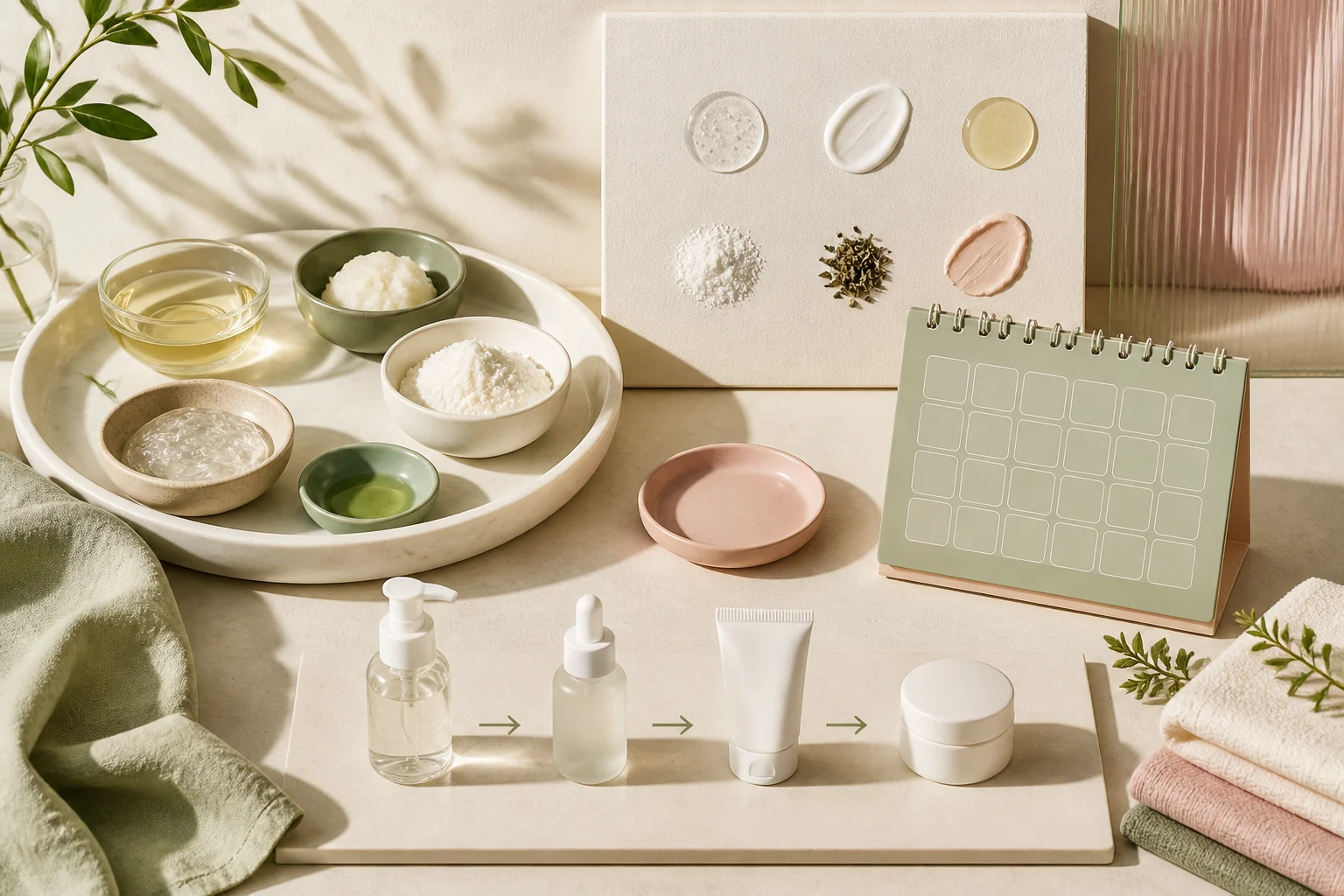
- Centella asiatica (cica, tiger grass) — has the most documented evidence for stretch mark risk reduction. A 1991 study showed reduced incidence in women using a centella-based preparation during pregnancy. Some subsequent research supports this finding.
- Hyaluronic acid — modest evidence for reducing severity when applied during the stretching period.
- Almond oil — limited evidence, but a 2012 study showed slight reduction in stretch mark development with daily massage during pregnancy.
- Vitamin E — popular but research is mixed. Some studies show benefit, others don’t.
For treatment of fresh (red/purple) stretch marks
- Topical tretinoin (prescription retinoid) — the most-studied treatment with the best evidence. Multiple controlled trials show measurable improvement in red stretch marks with 0.025-0.1% tretinoin applied nightly for 3-6 months. Cannot be used during pregnancy or breastfeeding.
- Glycolic acid + tretinoin combination — slightly more effective than tretinoin alone for striae rubrae.
- Centella asiatica — modest evidence for fading fresh stretch marks.
For treatment of mature (white/silvery) stretch marks
This is where the honest answer gets bleaker. Mature white stretch marks are very difficult to improve topically. The best evidence supports in-office procedures:
- Fractional laser therapy — meaningful improvement in stretch mark appearance with multiple treatments. Both ablative (CO2, Erbium) and non-ablative fractional lasers have evidence.
- Microneedling (medical-grade, with or without radiofrequency) — stimulates collagen production in the stretch mark area. Multiple sessions required.
- Microdermabrasion — limited improvement, less effective than newer modalities but more accessible.
Topical creams have minimal effect on mature stretch marks despite marketing claims.
What probably doesn’t work (despite popular belief)
Cocoa butter
The most-marketed stretch mark risk reduction ingredient. Multiple controlled studies have shown no significant effect on stretch mark incidence during pregnancy. It’s a fine moisturizer; it doesn’t prevent stretch marks.
Olive oil
Same story. No evidence of preventive benefit. May cause irritation in some users due to its oleic acid content disrupting the skin barrier.
“Stretch mark removal” creams that aren’t tretinoin
Products promising to “erase” or “remove” stretch marks without containing prescription tretinoin are overstating their case. The active ingredients in most over-the-counter stretch mark creams have minimal evidence for the specific claim of reversing established stretch marks.
Vitamin E oil
Despite popular belief, vitamin E oil has not been shown to improve stretch marks or scars in controlled studies. It also commonly causes contact dermatitis in users. The widespread recommendation is mostly tradition rather than evidence.
Best stretch mark products by use case
For risk reduction during pregnancy (used optimistically)
Apply daily from early pregnancy onward to areas most likely to develop stretch marks (belly, breasts, hips, thighs). Massage in for 1-2 minutes per area.
- Bio-Oil Skincare Oil ($15) — the most-studied of the over-the-counter options. Contains vitamin A (not the retinoid form, so pregnancy-conscious), vitamin E, chamomile, lavender, and rosemary. Multiple smaller studies suggest some benefit. Lightweight, absorbs well.
- Mederma Stretch Marks Therapy ($16) — contains cepalin (onion extract), centella asiatica, and hyaluronic acid. Evidence is modest but exists.
- Mustela Stretch Marks Recovery Serum ($45) — contains hyaluronic acid and centella. Targeted for postpartum but suitable for pregnancy risk reduction too.
- Earth Mama Belly Butter ($23) — pregnancy-targeted, shea butter base with centella and herbs. Heavier texture for very dry skin.
- Burt’s Bees Mama Bee Belly Butter ($10) — basic shea butter formulation, well-tolerated, affordable.
For fading fresh (red/purple) stretch marks postpartum
The most effective option is prescription tretinoin (cannot be used while breastfeeding). Over-the-counter options:
- The Ordinary Granactive Retinoid 2% Emulsion ($14) — retinoid alternative for use postpartum after weaning. Apply nightly to fresh stretch marks.
- Differin Gel (adapalene 0.1%) ($15) — over-the-counter retinoid; cannot be used while breastfeeding but excellent for fading fresh stretch marks afterward.
- Bio-Oil — continues to be useful for fresh stretch marks (still pregnancy-conscious).
- Mederma Stretch Marks Therapy — same ingredients work for postpartum fading.
For mature white stretch marks
Topical products produce minimal results. Better options:
- Microneedling (at-home) — derma rollers (0.5mm needles) used 1-2 times per week with a hyaluronic acid serum. Modest improvement over 6+ months.
- In-office treatments — fractional laser, professional microneedling with PRP, RF microneedling. Real improvement but costly and requires multiple sessions.
- Topical tretinoin combined with at-home microneedling — can produce modest improvement over 12+ months. Most realistic at-home approach.
How to maximize whatever benefit topical products offer
If you’re going to use a stretch mark cream, technique matters as much as product choice:
1. Start early
For risk reduction, begin daily application by the second trimester at latest. Earlier is better. Don’t wait until you can see the skin stretching — that means stretch marks are already forming.
2. Apply generously and consistently
A small dab once a week does nothing. Generous application (enough to leave a visible film for a few minutes), twice daily, on all at-risk areas, for the duration of the stretching period.
3. Massage during application
Spend 1-2 minutes per area working the product in with gentle circular massage. The massage itself may have modest benefit by improving local circulation and supporting collagen. It also ensures more even application.
4. Hydrate consistently
Drink water. Eat protein. The skin’s elasticity depends partly on internal hydration and nutrient status. Topical care without basic systemic care is fighting half the battle.
5. Manage weight gain pace (during pregnancy)
Steady weight gain at the medically recommended pace is associated with fewer stretch marks than rapid weight gain in shorter periods. This isn’t about restricting calories — it’s about following the gradual gain pattern your OB recommends.
6. Continue postpartum
The first 6-12 months after pregnancy is when fresh stretch marks are most responsive to treatment. Continuing daily care during this period (transitioning to retinoids after weaning if breastfeeding) maximizes fading.
What about C-section scars?
Different from stretch marks but often mentioned together. For C-section scars specifically:
- Wait until fully healed (typically 6-8 weeks postpartum, confirmed by your OB) before applying anything to the incision.
- Silicone-based treatments (silicone strips, silicone gel sheets, ScarAway, Mederma Quick Dry Oil) have the strongest evidence for improving scar appearance. Apply daily for 3-6 months.
- Massage the healed scar with consistent light pressure for 5 minutes daily to break up adhesions.
- Sunscreen on the scar for the first 12 months — UV exposure can permanently darken fresh scars.
Frequently asked questions
How early in pregnancy should I start stretch mark cream?
Second trimester at latest. Some women start in the first trimester, which is fine but provides no proven advantage. Daily application from around week 12-14 onward is reasonable.
Are essential oils safe to use during pregnancy for stretch marks?
Most are, but a few specific ones (rosemary, sage, basil, peppermint at high concentrations) are best avoided during pregnancy. Check the ingredient list of any “natural” stretch mark oil for these. Lavender, chamomile, and most floral oils are generally considered fine in modest concentrations.
Will my stretch marks fade on their own without treatment?
Fresh (red/purple) stretch marks will lighten significantly over 12-24 months with no treatment at all — that’s their natural progression to silvery/white. Treatment accelerates and amplifies this fading. Mature white stretch marks will not fade significantly without active intervention.
I had stretch marks in a previous pregnancy. Will I get them again?
Likely yes, though severity varies. Existing stretch marks often worsen with subsequent pregnancies, and new ones often form. Strict daily care from early pregnancy may reduce severity but won’t reliably prevent occurrence.
Can I use stretch mark cream while breastfeeding?
Most over-the-counter stretch mark creams are often considered lower-risk during breastfeeding. Avoid: anything containing retinoids (retinol, tretinoin, adapalene), high concentrations of essential oils, or salicylic acid above 2%. Bio-Oil and most cocoa butter / shea butter formulations are fine.
How long until I see results from stretch mark cream?
For risk reduction, you’ll never know definitively — you can’t compare to the version of yourself that didn’t use the cream. For treatment of fresh stretch marks, expect 8-12 weeks of consistent daily application before visible fading; 6+ months for substantial change.
Are stretch mark removal lasers worth the cost?
Honestly, often yes — IF you have meaningful stretch marks that bother you AND budget for the multiple sessions required. Fractional laser treatment typically costs $300-800 per session, with 4-6 sessions recommended. Total investment $1,200-5,000 for significant improvement. Not for everyone, but it produces visible cosmetic changes that topicals can’t match.
When to see a dermatologist
- Stretch marks that are accompanied by skin thinning, easy bruising, or weight changes not explained by lifestyle — these can indicate underlying conditions (Cushing’s syndrome, prolonged steroid use complications)
- Stretch marks that are itching severely or showing color changes that don’t fit the typical pattern
- Interest in prescription tretinoin treatment for fresh stretch marks (after pregnancy and breastfeeding)
- Interest in laser or other in-office treatments for established stretch marks
- If stretch marks are affecting your mental health or quality of life significantly
The bottom line
The honest assessment of stretch mark creams: most don’t prevent stretch marks reliably, none erase mature white stretch marks, and the evidence is genuinely modest across the category. That said, daily application of a well-chosen product during pregnancy may slightly reduce severity for some women, and fresh stretch marks postpartum DO respond to consistent topical treatment over months.
The reasonable picks:
- During pregnancy: Bio-Oil Skincare Oil ($15) or Mederma Stretch Marks Therapy ($16). Daily, generous, massaged in.
- Postpartum (after breastfeeding): The Ordinary Granactive Retinoid 2% or Differin Gel 0.1% — applied nightly to fresh stretch marks. Combine with daily moisturizer.
- For mature white stretch marks: Topicals do little. If improvement matters to you, consider professional treatments (laser, RF microneedling) over expensive creams.
Don’t spend $80 on a “luxury” stretch mark cream expecting miracles. The marketing far outpaces the evidence. Save the money for either Bio-Oil now or — if it really matters to you — laser treatment later.
And remember: stretch marks are a normal feature of human skin under stretch. Most women have them. They tend to fade significantly on their own with time. The cultural pressure to eliminate them entirely is unrealistic; the goal of “less prominent and lighter over time” is achievable. The goal of “completely gone” usually isn’t.