
Editorial note: This article is for general skincare education only. It does not diagnose, treat, or replace advice from a dermatologist, OB-GYN, or other licensed clinician. If you are pregnant, breastfeeding, using prescription medications, or dealing with persistent or severe symptoms, confirm product and ingredient choices with your healthcare provider.
Vitamin C is one of the few skincare actives with serious clinical evidence and meaningful results for dark spots. It’s also one of the most over-marketed, with hundreds of products competing for the same shelf space — some excellent, many essentially useless. This guide separates them.
How vitamin C actually fades dark spots
Topical vitamin C — specifically L-ascorbic acid, the active form — works through several mechanisms on hyperpigmentation:
It inhibits tyrosinase. Tyrosinase is the enzyme your skin uses to produce melanin (the dark pigment). When tyrosinase activity is reduced, your skin makes less new pigment, particularly in areas where production was overactive (sun spots, post-acne marks, melasma).
It reduces oxidative stress. Much of dark spot formation is driven by oxidative damage from UV. As an antioxidant, vitamin C neutralizes those free radicals before they trigger pigment production. This prevents NEW dark spots more effectively than it removes existing ones.
It supports collagen synthesis. Improved collagen architecture creates more uniform light reflection, which makes existing pigment look less prominent visually.
It accelerates cell turnover modestly. Helps existing pigmented cells move toward the surface and shed.
Together, these effects produce gradual fading of existing dark spots and meaningful risk reduction of new ones. Timeline: visible change typically begins at 8-12 weeks of consistent use, with substantial results at 4-6 months.
The form matters as much as the brand
The label says “vitamin C” — but vitamin C in skincare exists in many different chemical forms with very different properties.
L-ascorbic acid (LAA) — the gold standard
The active form. Has the most clinical research, the strongest documented effects, and the highest potency for dark spots.
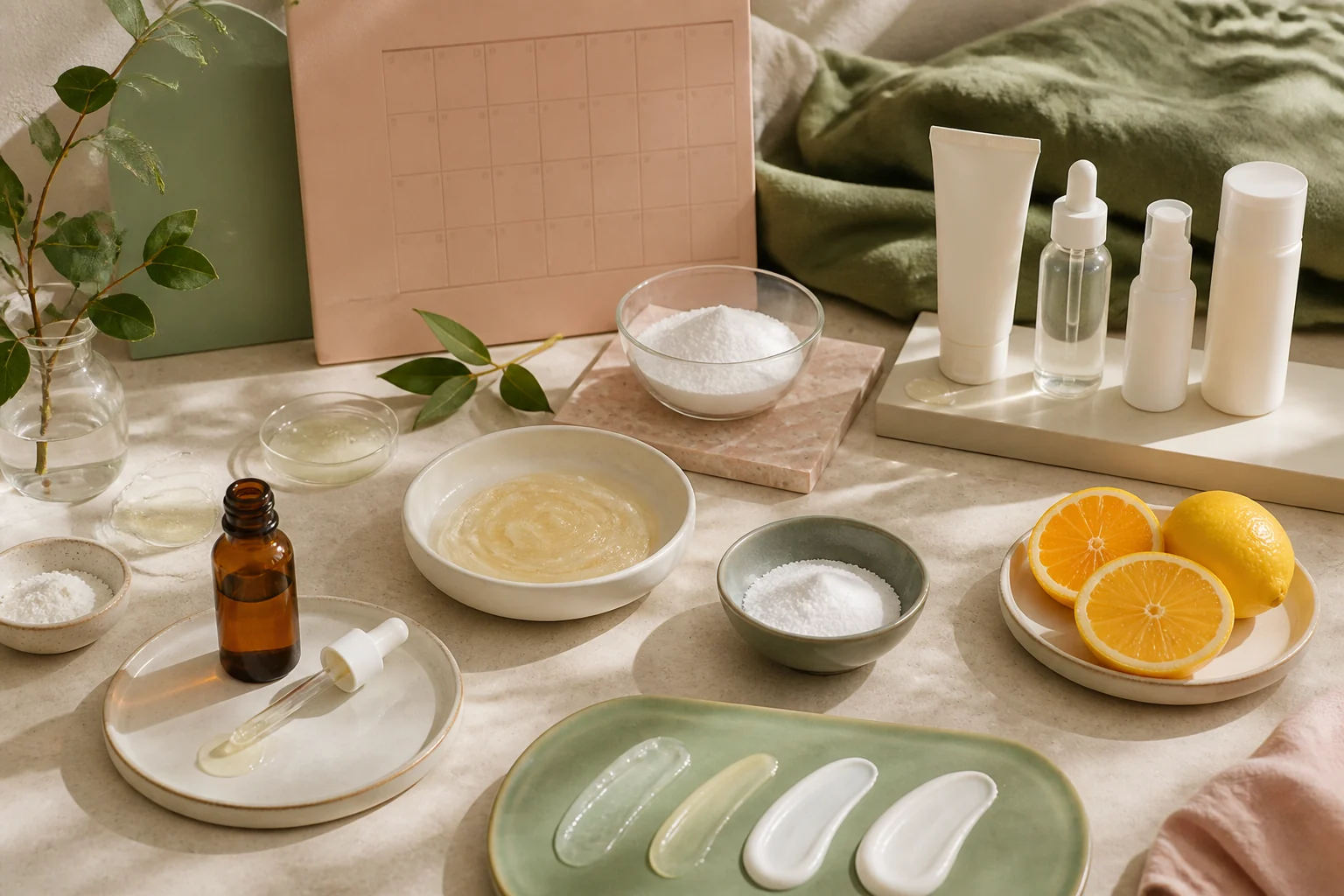
Trade-offs: LAA is unstable. It oxidizes (turns brown or yellow) when exposed to air, water, light, or heat. Once oxidized, it’s less effective. Quality formulations include stabilizers and proper packaging to extend shelf life.
Effective concentration: 10-20%. Studies show diminishing returns above 20%. Lower than 10% has modest effects.
pH matters: LAA only penetrates skin at pH below 3.5. Many “vitamin C” products are formulated at higher pH and don’t deliver the active ingredient to where it can work. Reputable brands disclose pH; if they don’t, that’s a flag.
Vitamin C derivatives — gentler alternatives
For sensitive skin or rosacea-prone users, several derivatives provide vitamin C’s benefits with less irritation potential:
- Sodium ascorbyl phosphate (SAP) — stable, water-soluble, gentler. Less potent than LAA but tolerated better.
- Magnesium ascorbyl phosphate (MAP) — similar to SAP. Often used in formulations marketed to sensitive skin.
- Tetrahexyldecyl ascorbate (THD ascorbate) — oil-soluble derivative, very stable, often used in premium serums. Effective and tolerable but expensive.
- Ascorbyl glucoside — stable but requires conversion in the skin to become active. Modest effects.
- 3-O-ethyl ascorbic acid — newer derivative, stable, good penetration, comparable efficacy to LAA in some studies.
For dark spots specifically, LAA at 15-20% remains the gold standard. The derivatives are valuable for users who can’t tolerate LAA.
What may help in a vitamin C serum (beyond the C)
Quality vitamin C serums include supporting ingredients that improve stability and amplify effects:
- Vitamin E (tocopherol) — works synergistically with vitamin C, regenerating it after it neutralizes a free radical. Studies show LAA + tocopherol is significantly more effective than either alone.
- Ferulic acid — stabilizes vitamin C and amplifies its antioxidant effect. The famous Skinceuticals C E Ferulic formulation pioneered this combination.
- Hyaluronic acid — neutral support; counters any drying effect from LAA’s acidity.
- Niacinamide — historically a controversial pairing with LAA, but modern formulations show they coexist fine. Adds complementary anti-pigment effects.
What’s NOT a sign of quality
- “24K gold infused” or “diamond particles” — pure marketing, no skincare benefit
- “Powered by exotic plant extracts” — usually marketing language for negligible amounts of plant-derived ingredients
- “Ultra-high 30% vitamin C” — above 20%, more irritation without better results
- Pretty colors — well-formulated LAA is colorless to pale yellow. Bright orange or pink means added dyes (or oxidation).
- Strong fragrance — masking the actual product smell, often indicates lower-quality formulation
Best vitamin C serums for dark spots — by category
Premium picks (worth the money for serious dark spot treatment)
- Skinceuticals C E Ferulic ($182) — 15% LAA + vitamin E + ferulic acid. The reference standard. Most-studied formulation. Expensive but each bottle lasts 3-4 months with proper application.
- Skinceuticals Phloretin CF ($182) — alternative formulation for oilier skin, with phloretin instead of vitamin E.
- SkinMedica TNS Vitamin C Complex ($120) — premium but well-formulated, includes growth factors.
Mid-tier (excellent value for results)
- Maelove Glow Maker Vitamin C Serum ($30) — 15% LAA + ferulic acid + vitamin E. Often described as the “C E Ferulic dupe.” Genuinely effective at one-sixth the price.
- Drunk Elephant C-Firma Fresh Day Serum ($80) — 15% LAA with stabilizers. Comes with separate activator powder to mix at use to maintain freshness.
- Mad Hippie Vitamin C Serum ($34) — uses sodium ascorbyl phosphate. Gentler option for sensitive users; effective for risk reduction more than aggressive fading.
- Naturium Vitamin C Complex Serum ($30) — 15% combined vitamin C forms (LAA, THD, sodium ascorbyl phosphate). Multi-form approach.
Budget picks ($20 and under)
- Timeless 20% Vitamin C + E Ferulic Acid Serum ($30 for 1oz, often on sale for under $20) — surprising quality at the price. 20% LAA with vitamin E and ferulic acid. Strong choice if your skin tolerates higher concentration.
- The Ordinary Vitamin C Suspension 23% + HA Spheres 2% ($8) — thick, slightly grainy texture (the LAA is suspended, not fully dissolved). Effective if you can tolerate the texture.
- The Ordinary Ascorbyl Glucoside Solution 12% ($14) — gentle derivative option for sensitive skin.
- Garnier Green Labs Vitamin C Brightening Serum ($18) — drugstore option, performs surprisingly well for the price.
For sensitive or rosacea-prone skin
- Paula’s Choice C5 Super Boost Eye Cream ($45) — for the eye area specifically; uses gentler vitamin C derivatives
- iS Clinical Pro-Heal Serum Advance+ ($168) — premium, uses 15% LAA but with extensive anti-inflammatory support
- The Ordinary Magnesium Ascorbyl Phosphate 10% ($12) — gentlest derivative option
How to use vitamin C for maximum dark spot fading
Application protocol
- Apply in the morning to clean, dry skin. Mornings make sense because vitamin C amplifies sunscreen’s effectiveness.
- Use 3-5 drops across the entire face and neck. Patting in rather than rubbing reduces absorption-related irritation.
- Wait 1-2 minutes before next products. Some users with sensitive skin prefer to wait 5-10 minutes.
- Follow with moisturizer. Vitamin C is slightly acidic and can be drying.
- Always finish with sunscreen. Critical. Without daily SPF, vitamin C use is wasted effort because new dark spots form as fast as old ones fade.
If you’re sensitive
- Start every other day rather than daily
- Apply over moisturizer rather than directly on bare skin (reduces concentration that reaches skin)
- Choose a derivative (SAP, MAP, THD) instead of LAA initially
- Avoid combining with high-concentration retinol the same morning
Storage matters more than people realize
L-ascorbic acid oxidizes when exposed to air, water, light, or heat. Practical protection:
- Store away from sunlight — dark cabinet, not bathroom shelf
- Keep the cap tightly closed
- If the serum turns dark orange or brown, it has oxidized — discard
- Don’t store in the bathroom if you have a steamy shower routine
- Some brands recommend refrigeration; not strictly necessary for stabilized formulations but doesn’t hurt
What to pair with vitamin C for dark spots
Vitamin C is most effective for dark spots when combined with other actives in a comprehensive routine:
Morning (with vitamin C)
- Gentle cleanser
- Vitamin C serum (15-20% LAA preferred)
- Niacinamide serum (5-10%) — additive anti-pigment effect
- Moisturizer
- Mineral sunscreen with iron oxides (tinted) — protects against UV AND visible light, which also drives pigmentation
Evening (rotation of complementary actives)
- Retinol or retinoid — accelerates cell turnover, gradually fades existing pigment
- Azelaic acid 10-15% — pigmentation, inflammation, and acne support
- Alpha arbutin or tranexamic acid — specifically anti-pigmentation
- Hydroquinone (prescription) — the most aggressive pigmentation treatment, used under dermatologist supervision
Realistic expectations
Sun spots (solar lentigines): Respond well to vitamin C combined with sunscreen. Visible fading at 8-12 weeks; substantial fading at 6 months. Often need to be paired with retinol or AHAs for fastest results.
Post-inflammatory hyperpigmentation (PIH) from acne or other inflammation: Responds excellently. Vitamin C is one of the best ingredients for fading these darker marks. Timeline 4-12 weeks.
Melasma: Modest response to vitamin C alone. More effective when combined with strict sun protection and other actives (azelaic acid, hydroquinone, tranexamic acid). Vitamin C is supportive rather than transformative for melasma.
Freckles: Limited fading. Freckles are heavily genetic and tend to return with sun exposure even after fading. Vitamin C may lighten them slightly with consistent use.
Acne scars (pitted or textured): Vitamin C addresses pigmented scars but not textural ones. Don’t expect filling effects on pitted scars.
When to see a dermatologist
- Dark spots that aren’t fading after 6 months of consistent vitamin C use
- Any new dark spot, especially if it’s changing in size, color, or shape (rule out skin cancer)
- Extensive melasma that warrants prescription-level treatment
- Interest in in-office treatments (chemical peels, IPL, laser) that can accelerate results
- Significant skin sensitivity that limits topical options
Frequently asked questions
Can I use vitamin C with retinol?
Yes — but typically not at the same time of day. Vitamin C in the morning, retinol at night. The combination is well-established and synergistic for dark spots, but applying them simultaneously can compound irritation.
Why does my vitamin C serum sting?
L-ascorbic acid is acidic (low pH) — that’s how it penetrates skin. Mild stinging for 30-60 seconds is normal. Sustained burning means too high a concentration for your skin — drop to a derivative or lower percentage.
Should I use vitamin C if I’m pregnant?
Yes. Vitamin C is commonly discussed as lower-risk during pregnancy, but confirm with your clinician and helps with the pregnancy-related pigmentation (melasma) that affects many women during this period.
Can I use vitamin C and niacinamide together?
Yes. The old internet wisdom that they “cancel each other out” was based on flawed lab studies from the 1960s using unstabilized forms. Modern formulations combine them safely and effectively.
How long until I may notice results on my dark spots?
Realistic timeline: 8-12 weeks before visible fading begins. 4-6 months for substantial improvement. 12 months for maximum effect. If you’re 12 weeks in and seeing no change, evaluate whether you’re using enough product, applying daily, AND wearing sunscreen.
What if my serum turns brown?
Oxidized — the vitamin C has degraded. Brown to dark orange means the product is no longer effective. Slight pale yellow is normal for fresh LAA; bright orange or dark amber is degraded. Discard and replace.
Is more expensive vitamin C actually better?
Not categorically. Skinceuticals C E Ferulic ($182) is excellent. Maelove Glow Maker ($30) is also excellent and uses a very similar formulation. Above a certain quality threshold, premium pricing reflects brand and marketing more than formulation superiority.
The bottom line
For dark spots, vitamin C works — but only the right form, at the right concentration, applied consistently with sunscreen. The reference standard is 10-20% L-ascorbic acid combined with vitamin E and ferulic acid, applied every morning for at least 3-6 months.
The best balance of quality and price for most people is Maelove Glow Maker ($30) or Timeless 20% Vitamin C ($30). The premium option is Skinceuticals C E Ferulic ($182) if you want the most-studied formulation and don’t mind the price.
What matters more than the specific product is the consistency: every morning, generous application, always followed by sunscreen. The women who see dramatic dark spot fading are the ones who’ve been doing this every day for six months, not the ones with the most expensive serum.