

Editorial note: This article is for general skincare education only. It does not diagnose, treat, or replace advice from a dermatologist, OB-GYN, or other licensed clinician. If you are pregnant, breastfeeding, using prescription medications, or dealing with persistent or severe symptoms, confirm product and ingredient choices with your healthcare provider.
Niacinamide is one of the most-marketed skincare ingredients of the last decade. It’s also one of the few that actually delivers on its claims. For dark spots specifically — including post-acne marks, melasma, sun damage, and general uneven tone — niacinamide has earned its reputation through clinical evidence.
This guide covers what niacinamide is commonly used for, how it compares to other brightening ingredients, the realistic timeline for results, and the best products to try.
What niacinamide is
Niacinamide is a form of vitamin B3 (also called nicotinamide). In skincare, it’s used in topical concentrations of 2% to 10% — though most clinical evidence centers on 4–5%.
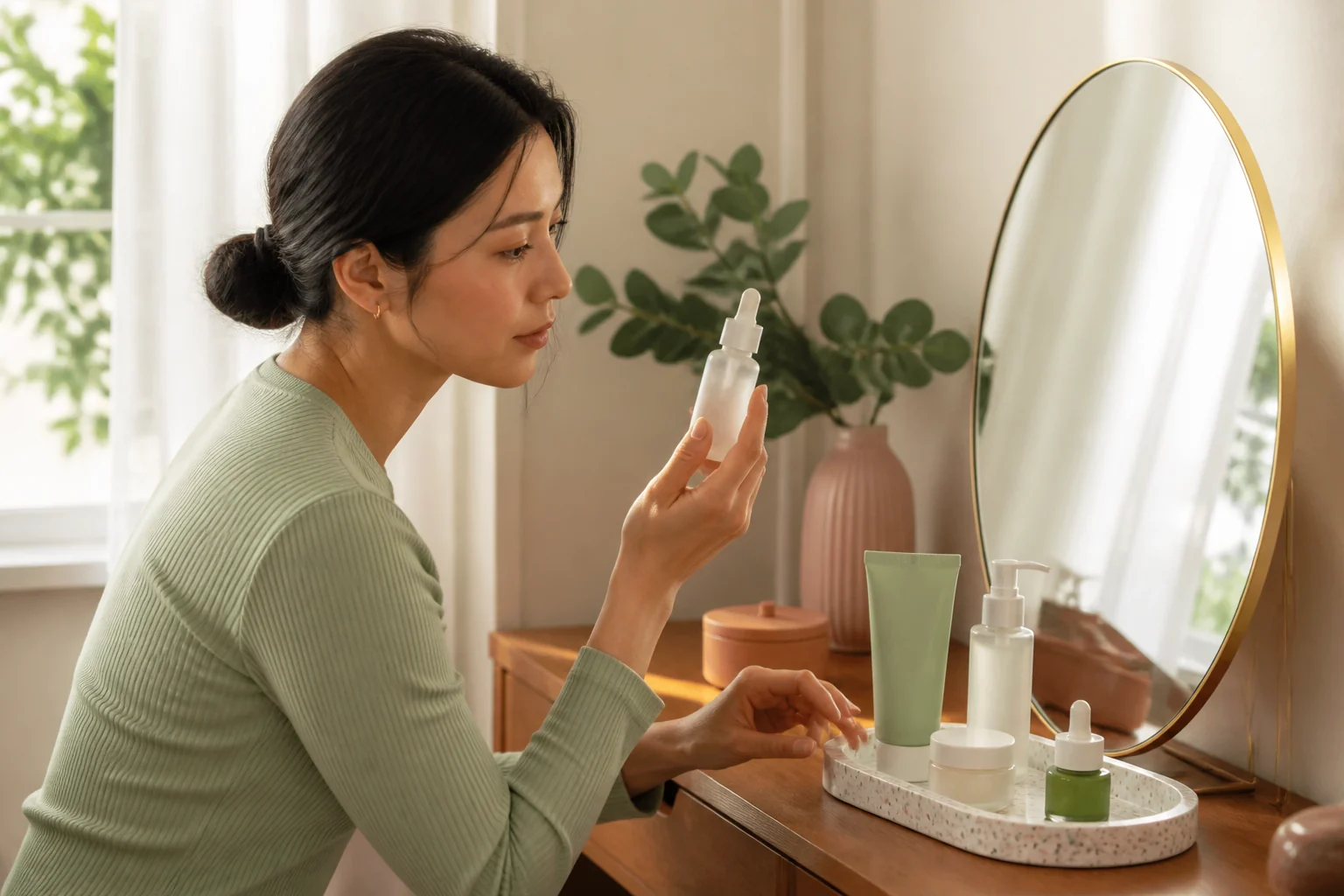
Unlike many actives, niacinamide is water-soluble, well-tolerated, stable in formulation, and works through multiple mechanisms. It’s not a niche ingredient — it’s increasingly the default base for serums, moisturizers, and even some cleansers.
How niacinamide affects dark spots
Niacinamide’s mechanism for treating hyperpigmentation is different from most other brightening ingredients. Most actives (hydroquinone, kojic acid, vitamin C, azelaic acid) inhibit melanin production. Niacinamide instead inhibits melanin transfer — specifically, the transfer of melanosomes (pigment-containing organelles) from melanocytes to surrounding keratinocytes.
Think of it this way: melanocytes produce pigment, but the visible darkening on your skin comes from that pigment being distributed to the surrounding cells. Niacinamide reduces this distribution by 35–68% in vitro studies. Less distribution means less visible darkening, even if melanin production itself is unchanged.
This is why niacinamide tends to produce gradual, even-toned improvements rather than dramatic spot-fading. It’s working at a different level than other actives.
The research evidence
Several published clinical studies have established niacinamide’s effects on hyperpigmentation:
5% niacinamide for melasma and facial hyperpigmentation
A 2002 study in the British Journal of Dermatology found 5% niacinamide significantly reduced hyperpigmentation in subjects over 8 weeks, with effects comparable to 4% hydroquinone for some patients. The niacinamide was better tolerated, with no rebound pigmentation on discontinuation.
4% niacinamide for post-inflammatory hyperpigmentation
Multiple studies have shown niacinamide accelerates the fading of post-inflammatory hyperpigmentation (the dark marks left after acne or skin injury) over 6–12 weeks of consistent use.
Combined with other actives
Niacinamide compounds well with other brightening ingredients. Studies combining niacinamide with vitamin C, retinol, or hydroxy acids consistently show better results than monotherapy with any single ingredient.
Reduced UV-induced pigmentation
Niacinamide has been shown to reduce the immediate pigmentation response to UV exposure, working as a complement to sunscreen rather than a replacement.
What kinds of dark spots niacinamide helps most
Post-inflammatory hyperpigmentation (PIH)
The brown marks left after acne, scratches, ingrown hairs, or other skin trauma. Niacinamide is one of the best-evidenced topical treatments for this. PIH usually responds within 8–12 weeks.
Melasma
Niacinamide is a useful supporting active for melasma. It’s typically used alongside vitamin C and azelaic acid for visible results. Less effective as monotherapy for melasma, but adds meaningful benefit in combination.
Mild to moderate sun spots
Sun spots (solar lentigines) respond modestly to niacinamide. Deep, well-established sun spots may need stronger treatments (in-office laser, prescription bleaching), but niacinamide is a sensible starting point for newer or lighter spots.
General uneven tone and dullness
Niacinamide produces visible change in overall skin tone and clarity within 6–8 weeks. This is often the most appreciated effect — not dramatic spot fading, but a more even, brighter overall complexion.
Acne-prone skin with frequent breakouts and resulting marks
For skin that breaks out and leaves marks repeatedly, niacinamide does double duty: helping with active inflammation and accelerating the fading of resulting hyperpigmentation. This is part of why niacinamide is in so many acne-focused products.
What niacinamide is less helpful for
- Deep, established melasma in the dermis — needs stronger interventions
- Old sun spots that have been present for years — often need laser or IPL
- Discoloration from skin diseases (lichen planus pigmentosus, drug-induced pigmentation) — needs medical evaluation
- Very dark, longstanding patches — typically need a multi-modal approach beyond topicals
How to use niacinamide effectively
Concentration
2–5% concentrations are well-studied and well-tolerated. 10% concentrations (like The Ordinary’s popular product) are also fine for most people but slightly more likely to cause irritation in sensitive skin.
For dark spots specifically, look for products with niacinamide at 4–10% as a primary listed ingredient.
Frequency
Daily use, morning and/or evening. Niacinamide is one of the few actives that can be used twice daily indefinitely without breaks. This is one of its biggest practical advantages — it integrates easily into any routine.
Application
Apply to clean dry skin. Allow 30–60 seconds for absorption before applying the next product.
Position in routine
Niacinamide is a water-based active and goes early in the routine, after cleansing and before heavier moisturizers or oils. It can be layered with:
- Other water-based serums (hyaluronic acid, vitamin C, peptides)
- Moisturizers and oils on top
- Sunscreen as the final morning step
Pairing niacinamide with other actives
Niacinamide + vitamin C
Outdated advice claimed these can’t be used together (concerns about niacin/nicotinic acid formation). Modern research has clarified that this is a non-issue at the concentrations used in well-formulated products. Niacinamide + vitamin C is one of the most-recommended combinations for general brightening.
Either layer them (vitamin C first, niacinamide second), use them in separate routines (vitamin C morning, niacinamide evening), or find a product that combines them at appropriate ratios.
Niacinamide + retinol
Excellent combination. Niacinamide reduces some of the irritation associated with retinol while contributing its own benefits. Many “advanced” retinol products are formulated with niacinamide for this reason.
Niacinamide + azelaic acid
Complementary mechanisms. Use azelaic acid in the evening, niacinamide in the morning, or layer them.
Niacinamide + AHA/BHA exfoliants
Compatible. Apply exfoliant first (allow it to do its work), then niacinamide once absorbed. Niacinamide can buffer some of the irritation from exfoliants.
Niacinamide + sunscreen
Niacinamide can be applied under any sunscreen. Some sunscreens are formulated with niacinamide already included (EltaMD UV Clear is the classic example).
Specific product recommendations
Affordable serums (under $20)
- The Ordinary Niacinamide 10% + Zinc 1% — the most-recommended starter. Thin, water-light texture. May cause slight stinging on very sensitive skin.
- Cerave Niacinamide Serum — drugstore option with ceramides included
- Cos De BAHA Niacinamide 10% Serum — Korean brand, well-formulated, mild
- InkeyList Niacinamide — affordable 10%, simple formulation
Mid-tier serums ($20–$60)
- Glossier Super Pure Niacinamide + Zinc — 5% niacinamide, gentle, good for sensitive skin
- Paula’s Choice 10% Niacinamide Booster — well-formulated, slightly more elegant than The Ordinary
- Skinceuticals Metacell Renewal B3 — combines niacinamide with glycerol and other actives
- Drunk Elephant B-Hydra Intensive Hydration Serum — 5% niacinamide plus hyaluronic acid
Niacinamide-containing moisturizers
- CeraVe PM Facial Moisturizing Lotion — affordable, niacinamide + ceramides
- La Roche-Posay Toleriane Double Repair — well-formulated barrier-support with niacinamide
- Olay Regenerist Whip Face Moisturizer — popular drugstore option with niacinamide
Niacinamide-containing sunscreens
- EltaMD UV Clear SPF 46 — the cult-favorite acne-friendly sunscreen, with niacinamide. Note: contains octinoxate, so swap for the mineral version (UV Pure) if pregnant or avoiding chemical filters.
- Supergoop Glowscreen SPF 40 — niacinamide plus hydrating actives in a tinted sunscreen
Combined niacinamide + vitamin C products
- The Ordinary Multi-Peptide + HA Serum — combines several actives including niacinamide
- SkinCeuticals Discoloration Defense — premium combination of tranexamic acid, niacinamide, and other brightening actives. Excellent for melasma.
Realistic timeline for dark spot improvement
- Weeks 1–4: Skin may feel smoother and look slightly more even overall. Major spot fading not yet visible.
- Weeks 4–8: Mild brightening becomes apparent. Post-inflammatory hyperpigmentation from recent breakouts starts fading visibly.
- Weeks 8–12: More established spots begin softening. Overall tone improvements compound.
- Weeks 12–24: Continued gradual improvement. Older, deeper pigmentation softens but rarely disappears entirely.
- Months 6–12: Maintenance phase. Skin tone improvements are visible to others (people start asking what you’re doing).
This is the realistic timeline. Anything promising dramatic results in days or weeks is overselling.
Side effects and contraindications
Generally well-tolerated
Niacinamide is one of the most universally tolerated actives. The vast majority of users have no adverse effects.
Possible mild irritation
Higher concentrations (10%+) can cause slight tingling, flushing, or warmth in sensitive individuals. Switch to a lower concentration (4–5%) if this happens.
Rare allergic reactions
True niacinamide allergy is rare but possible. If you develop a rash from a niacinamide product, discontinue and patch test other ingredients to identify the actual culprit.
Niacin flush is not the same as niacinamide reaction
Oral niacin (different vitamin B3 form) commonly causes a “niacin flush” — temporary skin redness and tingling. Topical niacinamide does NOT cause this. If you’ve reacted to oral niacin, you can still use topical niacinamide.
What niacinamide won’t replace
To set expectations honestly: niacinamide is a useful supporting active, but it’s not the most potent brightening ingredient available. For severe hyperpigmentation, niacinamide alone is rarely sufficient.
For meaningful results on stubborn dark spots, niacinamide is best used:
- Alongside vitamin C and azelaic acid
- Layered into a routine that includes retinoids and exfoliants
- Combined with strict daily sunscreen use
- Possibly supplemented with prescription treatments (hydroquinone, tranexamic acid) under dermatology guidance
- Possibly supplemented with in-office treatments (IPL, picosecond laser, chemical peels) for established pigmentation
Niacinamide is a foundation, not a single-handed solution.
Frequently asked questions
Can I use niacinamide if I have rosacea?
Yes, generally well-tolerated and often beneficial. Niacinamide reduces overall redness and supports the barrier in rosacea-prone skin. Start with 4–5% concentrations rather than 10% if you’re very reactive.
Is niacinamide often discussed as lower-risk during pregnancy, but worth confirming with your clinician?
Yes. Niacinamide is often considered lower-risk throughout pregnancy and breastfeeding. It’s one of the recommended actives for pregnancy melasma.
How much niacinamide is “too much”?
Concentrations above 10% are unnecessary and can increase irritation potential without proportionally better results. Most clinical studies use 2–5%. Stick to that range for routine use.
Why does my niacinamide serum sometimes turn yellow?
Some niacinamide formulations oxidize slightly over time and develop a slight yellow color. This isn’t necessarily a problem for the ingredient itself (niacinamide is stable) but may indicate the product is past its best — most should be used within 6 months of opening.
Can I use niacinamide on body skin?
Yes. Many body lotions contain niacinamide. It works for body hyperpigmentation (dark armpits, inner thighs, knees, elbows) the same way it works on face — slow but consistent improvement.
Does ingested niacinamide help skin?
Possibly modestly. Oral nicotinamide supplementation (typically 500 mg twice daily) has been studied for reducing skin cancer risk and improving certain dermatology conditions. The skin-brightening effects of oral supplementation aren’t as well-evidenced as topical, but the supplement is widely often considered lower-risk.
Will niacinamide make my pores smaller?
Pores don’t actually change size in a meaningful biological sense, but they can appear smaller. Niacinamide improves the appearance of pores by reducing sebum, supporting cell turnover, and tightening the skin around them. The visible change is real even if the underlying pore size hasn’t actually changed.
When to see a dermatologist
- Hyperpigmentation that doesn’t improve after 3–4 months of consistent niacinamide + sunscreen use
- Suspected melasma that you’d like properly evaluated and treated
- Interest in prescription-level brightening (hydroquinone, tretinoin, tranexamic acid)
- Interest in in-office treatments (chemical peels, IPL, laser)
- Any new or unusual pigmentation that might be something other than typical hyperpigmentation
The bottom line
Niacinamide is one of the best-evidenced and best-tolerated actives in modern skincare. For dark spots specifically, it delivers gradual, even-toned improvements over 8–24 weeks of consistent use.
It works through a unique mechanism (reducing pigment transfer rather than pigment production), which makes it complementary to nearly every other brightening ingredient. The downside is that it’s slower than stronger actives — but for many users, the trade-off (gentle, tolerable, daily-use-friendly) is worth it.
The Ordinary’s Niacinamide 10% + Zinc is the budget standard. CeraVe Niacinamide Serum is the drugstore equivalent with added barrier support. For more refined formulations, Glossier or Paula’s Choice are reliable mid-tier options.
Use it consistently. Pair it with daily sunscreen. Be patient through the first 8 weeks. By 12 weeks, you’ll see results worth keeping it in your routine permanently.