
Editorial note: This article is for general skincare education only. It does not diagnose, treat, or replace advice from a dermatologist, OB-GYN, or other licensed clinician. If you are pregnant, breastfeeding, using prescription medications, or dealing with persistent or severe symptoms, confirm product and ingredient choices with your healthcare provider.
Most skincare routines published online are written for normal skin. If you have rosacea and you’ve tried following one, you’ve probably ended up with worse skin than before you started.
This guide walks through a complete morning and evening routine designed for rosacea specifically — one that calms rather than provokes, supports rather than strips, and gives you something you can actually maintain over years.
The principles that make a rosacea routine work
Before the routine itself, the principles:
1. Fewer products, applied consistently. A 3–4 step routine that you do every day outperforms a 10-step routine that triggers flares. Rosacea responds to consistency more than to clever ingredient stacking.
2. Lukewarm water, never hot. Hot water dilates capillaries, contributes to flushing, and strips the barrier. Cool to lukewarm is the rule.
3. No physical exfoliation. No scrubs, no exfoliating mitts, no spin brushes, no aggressive towel-drying. Pat dry with a soft towel, every time.
4. One active at a time. If you’re using azelaic acid, don’t also use retinol that evening. If you’re using vitamin C in the morning, save the BHA cleanser for nights it’s needed. Layering actives is for stable skin, not rosacea skin.
5. Mineral sunscreen daily, no exceptions. UV is the single most reliable rosacea trigger. Tinted mineral SPF every morning, even on cloudy or indoor days. Reapply on sun-exposure days.
6. Patch test religiously. Inside of forearm, 3–5 days, before applying anywhere on the face. Skip this step and you’ll regret it.
The morning routine — 4 steps
Step 1: Rinse or skip the morning cleanse
Most rosacea skin does best with no morning cleanse, or just a splash of cool water. Cleansing twice daily can over-strip the barrier. If you wore overnight products (heavy moisturizer, face oil) you may want a gentle cleanse to remove residue, but a full sudsy wash is overkill in the morning.
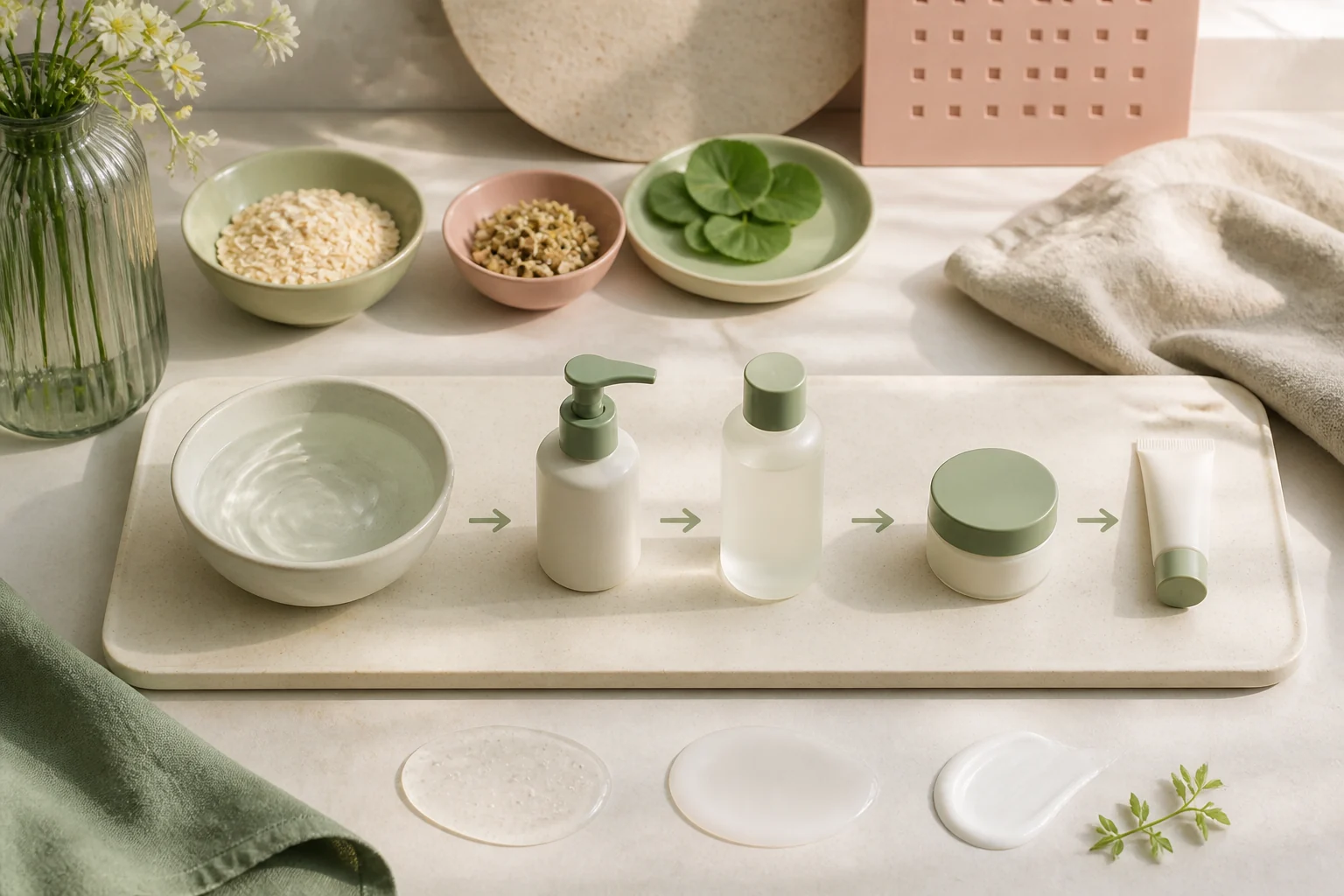
If you do morning cleanse, use:
- La Roche-Posay Toleriane Hydrating Gentle Cleanser
- Cetaphil Gentle Skin Cleanser
- Vanicream Gentle Facial Cleanser
Apply with damp fingers to a damp face. Massage gently for 15–20 seconds. Rinse with cool water. Pat dry — don’t rub.
Step 2: Niacinamide serum (5–10%)
Niacinamide is the most universally tolerated active for rosacea. It reduces inflammation, supports the skin barrier, and helps even out some of the chronic redness over time. Studies have shown 2–4% niacinamide reduces transepidermal water loss and improves barrier function meaningfully over 8 weeks.
Apply 3–4 drops to clean dry (or barely damp) skin. Press it in rather than rubbing. Wait 30–60 seconds for absorption before the next step.
Product options:
- The Ordinary Niacinamide 10% + Zinc 1% — affordable, effective, slight viscosity
- Paula’s Choice 10% Niacinamide Booster — slightly more elegant formulation
- Glossier Super Pure Niacinamide + Zinc — gentle, good for very reactive skin
Step 3: Moisturizer with ceramides
The moisturizer is the keystone of a rosacea routine. It’s reinforcing the compromised barrier that underlies most rosacea symptoms.
Apply 1–2 pumps or a dime-sized amount. Spread in upward motions, gently. Don’t aggressively massage. Make sure the entire face is covered, including the often-missed areas: jawline, temples, and the sides of the nose.
Product options:
- CeraVe Moisturizing Cream (in the tub) — drugstore classic
- La Roche-Posay Toleriane Double Repair — niacinamide + ceramides, ideal pairing
- First Aid Beauty Ultra Repair Cream — colloidal oatmeal for additional soothing
- Avene Tolerance Control Soothing Skin Recovery Cream — for the most reactive skin
Step 4: Tinted mineral sunscreen SPF 30+
Untinted mineral sunscreens can leave a white cast on the skin, which on rosacea-prone red skin can look uneven. More importantly, tinted formulations contain iron oxides that protect against visible light — which research has shown contributes to rosacea-related pigmentation and possibly to flushing.
Apply two finger-lengths worth, generously. Most people apply far too little and lose much of the protection.
Product options:
- EltaMD UV Elements Tinted SPF 44 — dermatologist favorite for rosacea
- Tower 28 SunnyDays Tinted SPF 30 — newer favorite, comes in tinted shades
- Colorescience Total Protection Face Shield Glow SPF 50 — premium, very elegant
- Australian Gold Botanical Tinted SPF 50 — affordable, drugstore
The evening routine — 4 steps
Step 1: Gentle cleanser
In the evening, a single cleanse is usually sufficient unless you’re wearing heavy makeup or sunscreen. If you are:
- Double cleanse: first an oil cleanser or micellar water to remove makeup and SPF, then a gentle water-based cleanser to clean the skin itself
- Skip the foaming cleanser entirely — cream or no-rinse options are kinder
Cleansers that work well:
- Same as morning — Toleriane Hydrating, Cetaphil, Vanicream
- For double cleansing: Bioderma Sensibio H2O (micellar) as first cleanse
- For heavy makeup: DHC Deep Cleansing Oil or CeraVe Hydrating Cleansing Oil first, then a gentle cleanser
Step 2: Targeted treatment — azelaic acid 10% or 15%
Azelaic acid is the most rosacea-effective active in the routine. It reduces inflammation, evens redness, and helps with both papulopustular (bumpy) and erythematotelangiectatic (flushing) rosacea over time.
Apply a pea-sized amount to clean dry skin, focusing on areas of redness, papules, or flushing. Tingling for the first 30–60 seconds is normal; persistent stinging is not.
Build up tolerance:
- Weeks 1–2: every other evening
- Weeks 3–4: nightly if well-tolerated
- Long-term: nightly, indefinitely
Product options:
- The Ordinary Azelaic Acid Suspension 10% — affordable, starter
- Paula’s Choice 10% Azelaic Acid Booster — slightly nicer formulation, combined with salicylic acid for papular rosacea
- Finacea (prescription, 15%) — gold standard for rosacea, ask your dermatologist
Step 3: Moisturizer (same as morning, or richer)
After the azelaic acid has absorbed (1–2 minutes), apply your moisturizer. The same product as morning works well; some people prefer a slightly richer night cream.
If your skin feels particularly dry at night:
- La Roche-Posay Cicaplast Baume B5 — multi-purpose barrier repair balm, can be layered as a final step
- Avene Skin Recovery Cream — for severely sensitive skin
- CeraVe PM Facial Moisturizing Lotion — niacinamide + ceramides + hyaluronic acid
Step 4 (optional): Facial oil for very dry nights
If you’re dealing with significant dryness — which is common with rosacea in winter or after introducing azelaic acid — a final facial oil can help.
- Squalane oil (The Ordinary or Biossance) — neutral, well-tolerated
- Jojoba oil — similar to skin’s own sebum, balancing
- Avene Eau Thermale Spring Water Mist — refreshing finish, not actually an oil but worth mentioning
Avoid: rosehip oil (some rosacea patients react), facial oils with essential oils, citrus-containing oils.
Weekly additions (if your skin is stable)
Once your baseline routine is calm and tolerated for 6+ weeks, you can experimentally add:
1–2x weekly: Centella ampoule or essence
Centella asiatica is anti-inflammatory, antioxidant, and supports wound healing. Studies in rosacea have shown meaningful reductions in redness and barrier improvement over weeks. Use as a serum step before moisturizer 1–2 times weekly, working up if tolerated.
- Skin1004 Madagascar Centella Ampoule
- Purito Centella Green Level Serum
- Dr. Jart+ Cicapair Tiger Grass Serum
1x weekly: Hydrating mask
A weekly sheet mask or cream mask focused on hydration (not exfoliation, not brightening) gives the skin a deeper hydration moment. Look for masks with hyaluronic acid, ceramides, panthenol, or centella.
- La Roche-Posay Hydraphase Intense Mask
- Klairs Rich Moist Soothing Sheet Mask
- Laneige Water Sleeping Mask (used as occasional overnight, not nightly)
1x every 2 weeks: Gentle exfoliation, if at all
Most rosacea skin does best with no exfoliation at all. If you absolutely want to try:
- PHA (polyhydroxy acid) toner used once every 2 weeks — gluconolactone, lactobionic acid. These are the gentlest exfoliants.
- Avoid: physical scrubs, retinoids until skin is very stable, glycolic acid above 3%
Routine adjustments for different rosacea presentations
Flushing-dominant (erythematotelangiectatic)
Focus on:
- Strict trigger identification and avoidance
- Tinted mineral sunscreen for visible light protection
- Cool washcloths or gel masks stored in the fridge for acute flushing
- Discuss vascular laser treatment (IPL, V-beam) with your dermatologist for visible capillaries — topicals can only do so much
- Brimonidine (Mirvaso) for episodic intense flushing, prescribed by a dermatologist
Papulopustular (bumpy rosacea)
Focus on:
- Azelaic acid 15% as your nightly treatment
- Discuss ivermectin 1% (Soolantra) with your dermatologist — addresses Demodex mites
- For inflammatory bumps, doxycycline 40 mg (sub-antibiotic dose) is sometimes prescribed
- Avoid heavy occlusive moisturizers that can trap inflammation
Ocular rosacea (involving the eyes)
Focus on:
- See an ophthalmologist or dermatologist familiar with ocular rosacea
- Daily eyelid hygiene with diluted baby shampoo or specific lid wipes
- Preservative-free artificial tears
- Avoid eye-area products with fragrance or active ingredients
- Omega-3 supplementation may help (discuss with your provider)
During pregnancy
Most rosacea treatments are commonly discussed as lower-risk during pregnancy, but confirm with your clinician (azelaic acid is historically categorized as lower-risk in pregnancy and widely recommended). Adjustments:
- Continue azelaic acid 10–15%
- Continue niacinamide
- Continue mineral sunscreen
- Avoid: prescription retinoids if you’d been using them, ivermectin (limited pregnancy data), brimonidine (limited pregnancy data)
Lifestyle factors that compound the routine
- Cool sleeping environment. Hot bedrooms compound morning flushing.
- Silk pillowcase. Reduces friction and may slightly help with persistent facial redness.
- Cool washcloth or jade roller stored in the fridge. Useful for acute flushing.
- Identify and reduce dietary triggers. Common ones: spicy food, alcohol (especially red wine), hot beverages, very hot or very cold drinks.
- Stress management. Stress is a documented rosacea trigger. Sleep, exercise, breathwork — find what works for you.
- Exercise smarter. Don’t avoid exercise (it has many skin and health benefits), but choose cooler conditions when possible. Rinse face with cool water immediately after.
What NOT to do
- Don’t use a facial cleansing brush (Clarisonic, Foreo) — too abrasive for rosacea
- Don’t use alcohol-based toners or “refreshing” mists
- Don’t apply ice directly to the face — paradoxically causes rebound flushing
- Don’t try aggressive at-home peels or microneedling
- Don’t layer multiple acids or actives at once
- Don’t believe single influencer recommendations — rosacea responds individually
- Don’t quit a working routine to try something new — boring consistency wins
When to see a dermatologist
- To formally clinically evaluate rosacea (vs. acne, vs. perioral dermatitis, vs. lupus)
- Persistent papules and pustules unresponsive to azelaic acid
- Eye involvement
- Visible capillaries you’d like treated
- Severe flushing affecting quality of life
- Any progression of phymatous changes (skin thickening)
The bottom line
A working rosacea routine looks unremarkable: cleanser, niacinamide, moisturizer, mineral sunscreen in the morning. Cleanser, azelaic acid, moisturizer in the evening. Boring, consistent, repeated for years.
The flashiness is in everything you’re NOT doing — not exfoliating, not chasing trends, not layering 7 actives. The discipline is in the avoidances as much as in the application.
This routine, applied faithfully for 8–12 weeks, will produce visible change for most rosacea cases. After 6 months, the changes are usually substantial. After a year, you’ll have something close to your best-possible skin.
The goal isn’t perfect skin. The goal is calm skin. Build a routine for calm, and most days you’ll get it.